Published: 16 June 2026
Summary
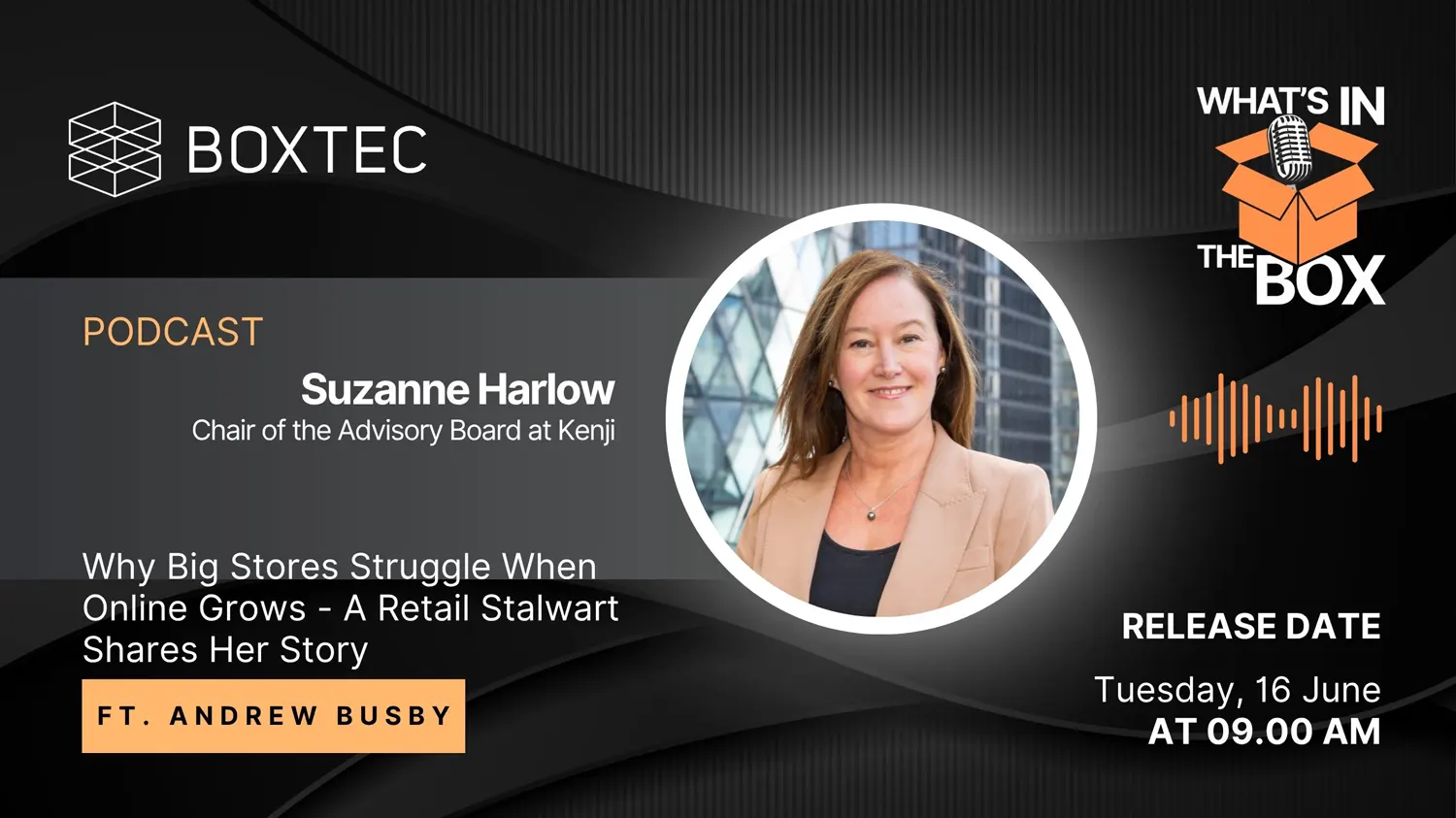
We talk with Suzanne Harlow about what really happens inside big retail when e-commerce grows, costs rise, and store investment cannot keep up. We trace lessons from Debenhams and Jack Wills to smaller, faster growth at Kenji, then end with a clear-eyed take on where AI is helping retail and where it is still confusing.
- Building a long career at Debenhams and what scale looks like in practice
- Why big department store estates struggle as online penetration rises
- Fixed costs, CapEx, and the growing expectations of in-store experience
- The Jack Wills turnaround challenge, cash constraints, and the decision to sell
- How lack of store investment can accelerate decline for experience-led brands
- Advising smaller retailers and why operational basics unlock growth
- The outsized impact of store managers and protecting frontline teams
- Retail’s current cost pressures and practical ways AI can help small teams
New episodes will be dropping every two weeks, so stay tuned.
Transcript
Host: 00:03
Welcome to What’s in the Box, the podcast brought to you by BOXTEC, customer engagement technology to protect and grow your business. BOXTEC delivers innovative and market-leading solutions that turn business ideas into a performing reality. From design and integration to ongoing support and maintenance, we’re with you every step of the way. Now, I have a very special guest with me today. She’s been described, and she’ll love me for this, she’ll be described as a retail stalwart. Now, we might get into that. I don’t know what that means, but anyway, I probably mean she’s been around retail for longer than she cares to remember. She started at Debenhams in 1994, where she covered a wide variety of senior roles, including group trading director of all product categories across clothing and accessories, beauty and gifting, home and restaurants, both in the UK and internationally. She served as PLC Board Director of Debenhams from December 2013 to October 2017, with responsibility for the global product, brand and sourcing proposition. In 2018, she became CEO of Jack Wills and led the business through to a sale one year later to Sports Direct International. Prior to her time at Jack Wills, she served on the advisory board of the British Fashion Council and was involved in Graduate Fashion Week. She is currently chair of the advisory board at Kenji. It’s a great pleasure to welcome Suzanne Harlow to What’s in the Box. Suzanne, welcome.
Suzanne Harlow: 01:26
Hi. Well, thank you for that introduction. Stalwart, I hate that word.
Host: 01:33
So do you know where I got that from? I got that because obviously I was searching for a bio for you, and that was how I think a number of years ago, Retail Week introduced you.
Suzanne Harlow: 01:45
Yes, let’s uh move on from that one quite quickly, I think.
Host: 01:49
Yeah, why not? We try to keep these podcasts to 20 minutes because you haven’t got longer than that, and I’m sure the audience don’t want to listen to hours and hours of this. So let’s get into it. Your journey, it’s fascinating. You spent a good number of years at Debenhams, which I outlined very briefly there. So let’s start with Debenhams. Tell us about your journey there, because obviously a very different business to the one which we now know as being an online platform.
Suzanne Harlow: 02:25
So, I guess if I took a step back and said Debenhams, well, two things. One, I was always asked why did I stay so long at Debenhams? I was there for over 20 years. And I stayed there, A, because I absolutely loved it, and actually, it was a really diverse role for me. So, I mean, you’ve talked about that in part of the introduction, but I did everything from premium beauty, restaurants. We had UK stores, international stores, a growing e-com business, designers at Debenhams; people forget that that business at the time was not far off 500 million turnover.
Host: 03:07
I thought that was great. I thought it was a really good concept.
Suzanne Harlow: 03:10
Yes, I mean it was fantastic. And so I loved it, but I loved it because for me personally, having started off as a buyer there and then progressing through to the main board, that was great, great experience. But also the people were fantastic, and there was lots of great stuff that happened across that time. At the time that I left, it was 3 billion turnover, and again, our I guess our lens on Debenhams now is through digital, it’s digital reinvention. But it was a £3 billion turnover business, so it was a big deal in a lot of major high streets. And so quite sad to see that go when it eventually went in 2021. But yes, I learned an awful lot in the time that I was there.
Host: 04:04
It was, I think, at its height, was well over, it was it was well over a hundred stores; am I right?
Suzanne Harlow: 04:12
Yes, we had about 170 stores in the UK. But then internationally, I think the bit that people don’t quite realise is we had about 70 stores, primarily franchise stores, but we also had stores in Denmark with 11 stores over there, of course. A big presence in the Middle East, that was a franchise arrangement with Alshaya. So whilst I think people have got this sort of fuzzy view of Debenhams as being a big department store and it’s high street, but equally, if you went to, you know, Dubai and Malaysia, there was a big presence of Debenhams overseas as well. Yes, so interesting times, particularly through the lens of what we think about Debenhams being today.
Host: 05:03
Yes. Now, one thing I want to ask you about the big department stores, because most of the Debenhams, were big boxes, weren’t they? So it’s always fascinating, it must take an awful lot of capital to keep that sort of estate running. Tell us a little bit about that. I’m sure at any one time the escalators have failed, at least one or two or half a dozen stores, or whatever.
Suzanne Harlow: 05:28
Absolutely spot on. That becomes then one of the challenges. I guess what one of the almost well, like a pivot point, let’s say, you’ve got the growth of e-commerce, but customers are choosing to shop in through a different channel. The market, your fashion, accessories, men’s, women’s kids, not particularly growing. We were seeing growth in beauty at the time. But so what you’ve got is the pie’s not getting any bigger, but people are choosing to shop in a number of different ways. But you’ve got all these fixed costs set in your big shops. And so you’re having to service all of your fulfilment costs through e-com, whilst the cost base is staying the same, and then you’ve got the CapEx challenge, and you’ve got customers then increasingly looking for more out of shops because they can get it quick and fast on e-com. So then it’s that whole conversation then about what’s the point of a shop. And so there’s, you know, people that whole thing about reinventing your retail proposition, making it relevant, investing in the store estate. But when you’ve got 160 stores and some of those are 100,000 square feet plus, the investment required on those is not insignificant. Depending on the category. So, if you’re looking at something like beauty, the beauty houses are very invested in making their beauty proposition look strong. And so there’s a shared funding that lives there. But if you’re trying to make the whole of your handbag departments across 170 stores look great, that is costly. And I remember there was a point when we were talking to investors and saying that all of our stores are profitable, but again, going back to that pivot time, the minute that e-com started really taking off and the overall sales number wasn’t going up that much to offset, then you have a challenge in stores, and therefore investment becomes much more challenged. So I left Debenham’s in 2017, nine years ago. And I guess what you’ve seen over the last nine years, accelerated by COVID, is it’s just no longer profitable to run 170 big shops in the way that it might have been before. Because simplistically, things have changed. E-com’s a much bigger channel now than it was then. And people can trade off fewer stalls, but fewer, better-looking stalls as well. And that was inevitable and accelerated through COVID.
Host: 08:18
Yes. And it makes you wonder whether if you know, this is crystal ball and it’s history, but, if it had been slimmed down to an estate maybe comparable to the current John Lewis, would it still be around on the high street?
Suzanne Harlow: 08:37
Yes, you’re right, that is crystal ball stuff. I think, again, going back to, maybe it was 2015, 2016, when we were saying all stores are profitable. I think had COVID not happened, and it was five or six years later, I think we would have been having a conversation that said we have got X number of stores that are not making money, and how do we reduce the store estate for sure? I just think that it was just the inevitability of the rise in e-com and shifting penetration there. So, I think I have rose-tinted lenses on Debenhams. I think it’s a shame that it’s no longer there. It’s a shame because in some towns it’s still there as a derelict building, but it couldn’t have continued forever in the in the way that it was at the time. So life moves on, doesn’t it?
Host: 09:32
Yes, absolutely. So we could we could talk forever on the years of Debenhams, but after that, you joined, I think it was in the August of 2018, Jack Wills as CEO?
Suzanne Harlow: 09:46
Yes, so I actually went in there in the spring. So I went in originally as an advisor. So Blue Gem at the time had a number of different retail formats. They had Liberty, Mammas and Pappas, Jack Wills. And at the time, this was early 2018, all three of those were underperforming in the portfolio. And so I’d been talking to these guys for a little while, and they just they basically said, can you come in and have a look at this one? We’ve got plans going on with the other two, but we need somebody to have a look at Jack Wills and tell us what’s going on. So I went in for four months just to do pretty much a look across the whole business. And that their exam question at the time was will we hit the budget for next year? And we were going into the autumn season, and my view was no, you won’t. We bought heavily, heavily into outerwear. We know how fickle the weather can be in the UK. So God forbid September, October is warm and mild. You know, you’re in trouble, and then you’re into margin dilution and so on. So we’d had all those conversations going on for a few months. I then went on holiday, had a phone call from them, and they said, look, we are we’ve been talking to Pete, who’s the founder. Pete’s leaving, and how do you feel about taking over? So I was under no illusion at the time that this wasn’t going to be an easy journey. We had just posted a significant loss on the accounts. Well, you know, much covered in the press at the time. Um and it was a really cash-constrained business. So I went from something that felt nice and relatively cosy at Debenhams, big team, relatively quite a lot of money to spend, to something that was in a completely different place. And that was a bit of a baptism of fire, I would say. It was a really, really, challenging business to be in. And you said earlier, we put a strategy in place, did loads of work around costs, about the proposition, about sourcing, all the normal stuff. But, by the time we got through to the following spring, it was just clear that unless either, the sun was shining, it was gloriously sunny every single day in spring and nothing went wrong, or we suddenly had an additional big cash injection, it was going to be challenging. So we took a decision in the spring to go down an accelerated sale process, and that ended up with Sports Direct taking the brand over in the August.
Suzanne Harlow: 12:30
So that felt like from the time that I went in in the spring, so it was all in all about 18 months, but a very different 18 months than the 20 odd years that I’d had when I was at Devon and before that.
Host: 12:41
Yes.
Suzanne Harlow: 12:44
And I think I’ve referred to it at times as the Wild West, just in terms of what was going on and what needed to be done. So, but again, it’s a bit of an overused phrase, but it was definitely a learning journey at the time.
Host: 12:58
Yes, yes. Now I’ve got to say about Jack Wills, I think one of the stores in your estate at the time was one of my favourite stores, and that’s the branch in Reigate.
Suzanne Harlow: 13:10
Oh, yes.
Host: 13:12
Which is, I can’t remember the name of the of the building, I can picture it, I know exactly where it is on the high street in Reigate. I think reputedly it’s where Winston Churchill once stayed, or something like that. But it was just amazing. You know, we talk about, I don’t like the term, when we say experiential retail. And that store was just the epitome of it. I remember going upstairs, yeah. I think it was arranged over three floors, and on one floor there was a bathroom, and it was still the old bath and the loo, the cistern, and all the garments were arranged around that and all the rest of it, and you just thought this is just fantastic.
Suzanne Harlow: 13:56
And I think and it’s a different story to the Debenhams story, but there’s similarities. Conceptually, the brand, if you look back through the archive of the heritage of the brand, it was world-class, it was leading, and you’re right, the whole experience in some of the stores were fantastic. But, the minute that the cash started to become a profitability hit, cash was a problem, and so you’ve got the same thing in there. The stores needed investment, some of the stores desperately needed investment, but the cash just wasn’t there to do it. And so your store estate then just starts to look worse and worse. And for a brand like Jack Wills, where the store experience is really important, you then start to have a bit of an ever-increasing problem on your hands. That, if you reflect on the heritage and the journey and the story, that was a shame. But again, I guess that brand needed to be reinvented for the consumer today, and that’s the journey that we’d started on, but just time and what we’d inherited and cash and all the that, what I’d call the boring stuff, got in the way. Something needed to change. But you’re right. Some of the stores were fantastic, really brilliant at the time.
Host: 15:32
Yes. So leaving Jack Wills, tell us what you’ve been doing since then. I know you do all sorts of things, keeping very busy. I think you’re spending a lot of time advising different retail businesses.
Suzanne Harlow: 15:44
Sure, yes. So I guess at the point I so after I’d left Jack Wills, I did a year and a half in the music education business, which I thought I quite liked the idea of trying something different, but I realised having tried something different, that wasn’t quite for me. So what I have done since then is I guess pivot back into consumer and retail. So I’ll probably do four main advisory roles, but two probably take most of the time. So Kenji, I’ve been doing Kenji for about two years now. It’s tiny relative to being in a three billion pound business or a hundred and odd million pound business. Turnover is about 20 million pounds, so small. But it’s interesting, and it has been an interesting couple of years. So the journey that they’ve been on is having to get themselves operationally sorted, and that’s required investment in senior team, and everything from health and safety in stores, around HR processes, and I would use that term, a lot of the boring stuff, that is critically important, has been fixed over the last of 12 to 18 months. The proposition fundamentally hasn’t changed, but by bringing in a great team around product and buying and just getting much more emphasis on that and about home brand development, it’s become a tighter proposition. We opened five stores last autumn, so we’ve got 17 stores. So, if you think about five in the last autumn period, for a business this size, that was quite some going. So, all opened on time and on budget, which is a miracle in itself. It’s purely a retail business, it’s not an e-com business, we’ve got a couple of stores internationally, and we’ve got various wholesale partners dotted around. What’s interesting, when people talk about retail, you know, challenges and this, that, and the other, we open five stores, three of them have absolutely knocked it out of the park. I mean, they have been exceptional. That’s Cardiff, Silverburn, and Milton Keynes. They’ve all been unbelievably strong. I think you’ve got to have the right proposition, stating the blindingly obvious. You need to have the right people in stores. But if you can get everything together, you’ve got the right level of theatre, you’ve got a footfall in a great location. When it all comes together, it comes together and it is fantastic. And so, yes, Kenji is a really interesting story. So just under 20 stores, we’ve got new stores planned for this coming year, we’ve got new partners that we’re working with in the UK and internationally. So it’s, for me personally, having worked in big, big you know, Debenhams, it’s been really interesting the last few years because what I’ve ended up doing, almost fallen into it really, is working with these smaller businesses like Kenji, with 20-25 million pound turnover. They’ve got lots of opportunities to grow, and it’s just finding the right way to do that and making sure that you’re operationally efficient as well at the same time.
Host: 19:32
Yes, yes. And I imagine what you said there about the success of those stores. I guess a lot of that is down to the store manager. Because I know every retailer, I remember my time, going back years at Superdrug, which every estate has their kind of top number of stores. And they always want to clone the store managers from those stores because they’re doing something, even though and it’s probably tighter today than it was back then, I think it’s still a command and control from the centre, and it’s task-driven, it’s adherence to planograms. But even so, those store managers seem to be able to do something different. I don’t know why, but I think it’s probably because of the all the incredibly sad stories that we hear about the abuse of frontline retail workers. So I’ve really developed a passion for the protection of frontline workers in retail. So I can imagine that a lot of that success is down to that.
Suzanne Harlow: 20:41
But do you know what? It’s a really interesting point, and I’ve only realised this in the last couple of years. So, when I was working for a Debenhams, you’ve got a store manager, you’ve got regionals, and then you’ve got lots of sales managers who are running big departments with big turnover. But because you’re in a bigger shop things can get lost in the noise. When you’re in a smaller chain of stores, so let’s say Kenji just under 20 stores, it’s really clear to everybody when a store isn’t performing. But then the converse of that is, and we’ve seen this probably in three or four locations in the last 12 months, work with those store managers to try and improve things, there comes a point when that’s no longer an option and you have to change. And what’s been incredible to me is you can bring a new store manager in, potentially change the team or not, and the difference in performance can be within a week, two weeks, and it can be incredibly positive. And I guess in bigger change, Jack Wills and so on, you just don’t see it in the same way. It’s still the same, but it’s really amplified when you’ve got a fewer number of stores, and also they’re much just physically, they’re just much smaller footprints. So when people say to me what’s positive about Kenji, you get the right people in the right stores, the dial-up on performance is incredible. It’s much more than I think I had realised from working with bigger stores. So it’s interesting.
Host: 22:44
Yes. Okay, well, we’re practically out of time. So let’s say we’ve got a minute. So this is a quick fire round as it were. 30 seconds, your thoughts on the challenges currently facing retail, and then another 30 seconds on the opportunities. So, challenges, what are they?
Suzanne Harlow: 23:05
Do you know what, it’s on whichever metric you look at it, it’s just cost challenges are ongoing at a point that consumers are still feeling cautious, I think. And also then, how do you mitigate cost increases through adoption of AI when there’s gazillions of things to choose from? That’s my view on retail today.
Host: 23:26
I think it’s confusing for a lot of people. I think we’re going to look back in a few years’ time, at this time now, 2026, and think, wow, we were in the dark. We were stumbling around in the dark, didn’t quite know. So opportunities, let’s end it on a positive.
Suzanne Harlow: 23:48
Yes. So I think great proposition and great people is just a multiplier effect. But actually, that I would just flip on its head what I have said, because in another business that I work with that has a strong e-com business as well, where we have used AI, we have seen an unbelievable benefit to doing that. Again, in a smaller business, where you don’t have lots and lots of people, where we’ve adopted it in marketing in particular, and digitally, that has been a huge benefit. And I think we’ve all been a bit blown away by the capabilities. So I think you’re right. I think in five years’ time we’ll think like, you know, we were just like in the dark ages. But where it’s being adopted and it’s just becoming seamlessly part of what you do, there is no doubt it could be transformational.
Host: 24:44
Yes, yes. That seems a great note to end on. Suzanne Harlow, thank you so much. Thank you to talk to you. So that’s all we’ve got time for from What’s in the Box for now. Uh, new episodes will be dropping every two weeks, so stay tuned. And if you want to find out more about BOXTEC, please follow the link in the description. Thank you so much for listening.
Suzanne Harlow: 25:05
Lovely to see you.