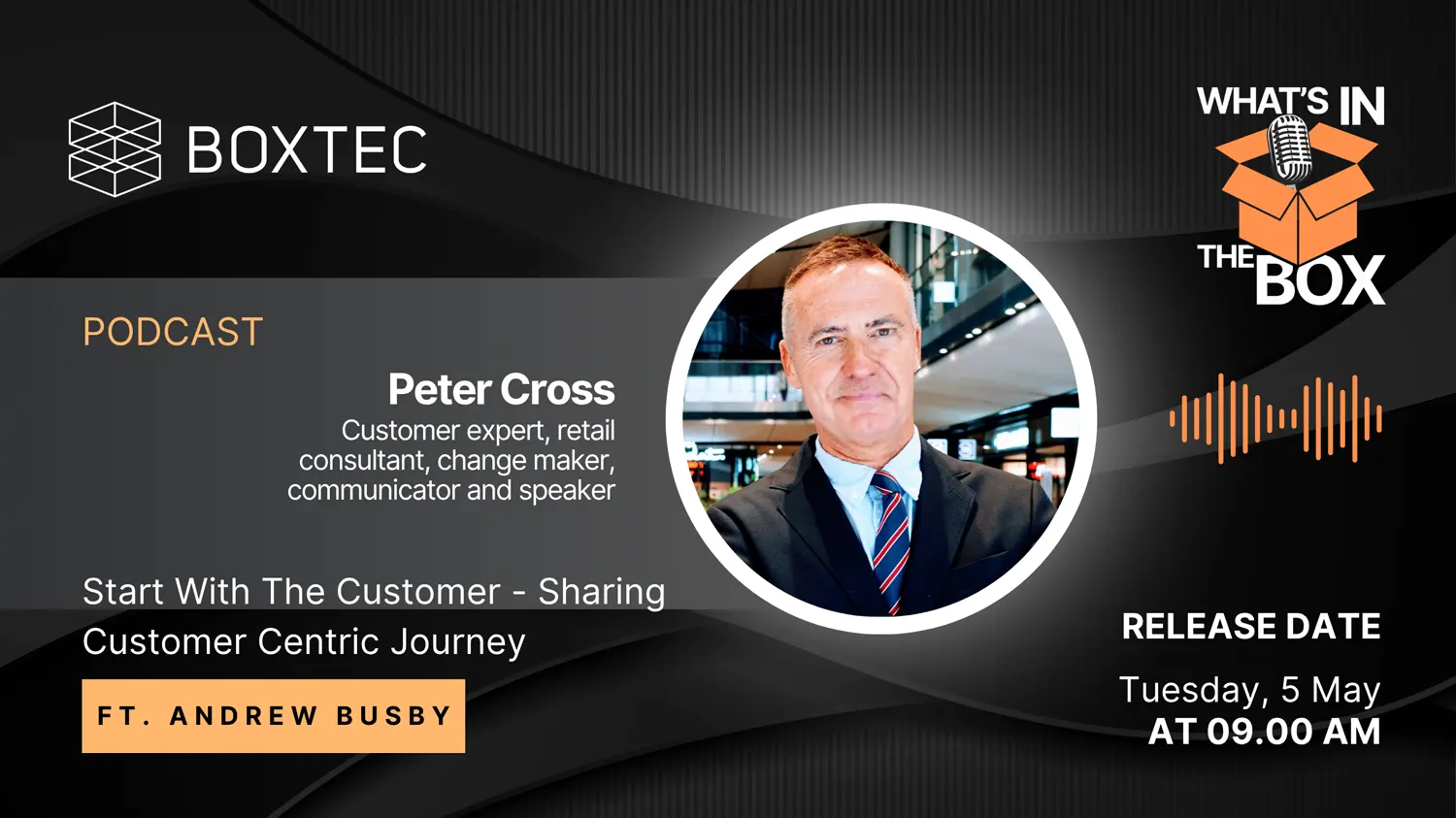
Published: 05 May 2026
Summary
Retail feels like it’s moving faster every month, yet many stores are somehow getting less human. From the floor of the Retail Technology Show at Excel, we grab Peter Cross for a candid conversation about what really drives customer experience and why so many “digital first” moves leave customers tired, not loyal.
We talk through Peter’s career highlights, including his years working with Mary Portas on retail projects that stretched from brand-building to the hard slog of high street reform. Then we jump inside John Lewis during what Peter calls the “golden years”, what the Partnership model teaches you about leadership, and why standing still can quietly erode a brand even when the market is chaotic. Along the way, we dig into Waitrose, the experience economy, and how physical retail has to work harder to earn repeat visits.
The heart of the conversation is customer service culture. Peter argues customers don’t care about “CX” or “omnichannel” language, they care about service, empathy, and trust. We unpack why self-checkout and over-automation often start with cost rather than customer needs, and why pride and empowerment on the frontline can unlock discretionary effort that no tech stack can replicate. We also touch on “Battle of the Brands”, and the uncomfortable but useful idea that John Lewis and Primark are converging through assortment, presentation, and in-store experiences.
If you care about retail strategy, physical store experience, and building loyalty the old-fashioned way with better service, hit play. Subscribe, share this with a retail friend, and leave a review so more people can find the show.
Transcript
Host: 00:03
Welcome to What’s in the Box coming to you from the Retail Technology Show at Excel. Now I’ve found a quiet corner and managed to grab none other than Peter Cross. Peter, welcome. Delighted to join you in this quiet corner in the midst of the mayhem. Somebody yesterday, it was our good friend Sarah Cole, who a lot of people know. I think she described it as the whirlwind, and I said, no, I think it’s more of a maelstrom. But either way, it’s busy out there on the floor. So I think that most people will know Peter, but I guess you’re probably best known for setting up a rather successful retail agency with the very well-known Mary Portas. We’ll talk a little bit about that. Then there are the good number of years, I think for 2013, something like that, where you joined John Lewis. And in particular, something that is dear to my heart, and I’m really keen to get your thoughts on, customer experience, which is what you were doing in your role there. And we’ll spend some time at the end because I know that you last autumn, I think it was September, you brought out a book, Start With A Customer. So yes, definitely want to hear all about that. And of course, in between all of that, we will hear about your latest TV appearance, which was The Battle of the Brands, which is quite an interesting one because it featured John Lewis and Primark, who, well, today, not sure when this episode is going to be aired, probably a few weeks from now after the Retail Technology Show. But today was the announcement that Primark had been demerged from ABF. So we’ll talk a little bit about that. But enough of me. I wanted to begin this with the journey that you were on. And yes, tell us because I’m sure people would be fascinated by the nine years you were working with Mary on setting up the agency. Yes, they were the they were golden years.
Peter Cross: 02:09
We were kind of mates and sort of neighbours, and Mary had already set up the agency actually when we first met. So she was in the early years of that, and I was a client. Apparently I was the worst client she ever had. Incredibly difficult. I always insisted that she came to the meetings. These are the stories she’s told many times. I wanted to spend time with her, but we really connected and we had a passion for retail, for customers, for high streets, for communities, for people, I guess. And that passion led to some magical, marvellous things, some fabulous clients, big and small, some bonkers stuff on the telly, and a slightly bizarre project with the government and saving the high street. But they were the best of years, Andrew. They really were. I mean, I remember at one point I said, You are so funny, you know. You yes, she knows her stuff, and she’s a world funny, but you are so funny, you deserve a television programme. And we went out there and we got one.
Host: 03:08
Yes, the Saving the High Street. I remember that. I remember because I kind of grew up south of Croydon, and that was one of the towns. And I remember going to that particular area, and I think I was probably one of the critics of it, but looking back, it was clear. I mean, everybody said, Oh, she’s doing this for self-promotion and the TV programme, blah, blah. But actually, it was well, it was a bit of a poison chalice, though, wasn’t it?
Peter Cross: 03:43
She certainly wasn’t doing it for any good any glory because there was no glory in it. It was hard slog. Thank God for the associations, for Helen at the BRC, it was Ice Gourley, then it was for Boots, who was running BITC, all the associated conventions, all these associations that gathered around us and tried to help us reach a number of conclusions that have stood the test of time. You know, if you read that report now, nothing’s changed. A lot of the courses, the digital dynamics changed, all these things, but ultimately the keys to a successful fight, haven’t changed. And we’re proud of the work, even though it was it was bloody hard work.
Host: 04:22
Yes. And then, of course, following that, we had, not one but two reports from our friend Mr. Grimsey on the high street.
Peter Cross: 04:34
There were a lot of people throwing stones.
Host: 04:36
Yes.
Peter Cross: 04:37
I’m eternally optimistic. And I said, listen, just join us. You know, just don’t throw stones. And there were a lot of stones thrown and a lot of other reports. And I mean they were fantastic times, but I know Mary, we’re proud of the work, however difficult it was.
Host: 04:53
Yes, you’re right. I mean, I’ve seen her on stage plenty of times at retail conferences, and she’s always great value, always has something to say. And probably the one person who I think, yes, it was a couple years ago at the Retail Technology Show. I think she’s the one and only person who kind of dominated Kate Hardcastle when she was being interviewed by Kate, who again knows her stuff. But Mary kind of took over that, but it was great fun. I mentioned John Lewis, so let’s talk about that. I believe it started with you being Communications Director with John Lewis, and then following that it was Customer Experience Director. Now, this was in what 2013 you began there? Tell us a bit about from then until now, I mean it’s been very well documented, the kind of roller coaster that the partnership has been on. Tell us a bit about what it was like working there in those days.
Peter Cross: 06:04
I you know, I feel very lucky because they were the golden years, you know. I had Andy Street, who was an extraordinary leader, and then Craig Ingalls, who was probably the best marketeer in the UK. Phenomenal people, and a very unique business, enjoying great success. Knew what it was, as a brand, as an offer, some of the best people in retail, and they’ve gone on to many really great things. And I learned a huge amount, I learnt about this unique model, this unique ownership model that has its complications and challenges, like many great things. But I, you know, when you’ve been a consultant and then you learn life on the other side of the of the fence, and you go back, you have a much rounder perspective on your own expertise and so on. So I really, really loved it. I feel very saddened about what happened in the past few years. God willing, they are now getting the brands back on track. Brilliant people have gone in there, many of which have returned there. But there’s work to do, particularly at John Lewis, because they were, as you say, well documented. I don’t want to be the first to throw stones, but at the very least the brand stood still, and a lot of people were caught up in that, not least the customer. So it’s fantastic news that it’s back on track and doing great things again.
Host: 07:40
And I think Sharon took a lot of flack in in the media. I think I was one of the few who didn’t join that particular bandwagon because I’d okay, we won’t debate here you know the whys and wherefores and whatever, but when you look back at that period, and of course, we were in the post-Brexit years, not making any comments on Brexit, positive or otherwise, but that was the situation. We were then going through COVID, and it was a tough time for a lot of people. And you could argue that was maybe the best that the partnership could have been navigated through quite choppy waters, but I think maybe it, yes, focusing more on I think the current leadership team across both the businesses is clearly very strong, and as you say, getting it back on track, and there’s some wonderful things. I think Waitrose, if I’m honest for me, is kind of punching below its weight. What I mean by that is I think that there’s space in the market for a really artisan, high-end, not all the stores, but just a handful really, foodie Emporium.
Peter Cross: 09:03
I wouldn’t be surprised if there is a very serious review underway of the role of the physical estate. You know, because M&S has advanced substantially in the last few years. So I’m quite sure, knowing the people that are in there now, that they will be really reviewing how to distance themselves further from the marketplace and the value, the discounters, you know, the value brands and M&S and all the other things that are happening in the food market. So that they will be doing a lot of soul searching about creating a greater gap in terms of the assortment and the physical experience particularly.
Host: 09:48
I agree, and it’s going to be interesting later this morning. I’ll be doing a fireside chat with Mark Blundell, who I know you know, Chief Retail Officer at Harrods, and I’m sure that the famous food hall will crop up in our conversation. And you kind of think, well, not replicating it, but taking maybe some cues from that and putting that into a number of Waitrose stores. I know the store at Coal Drops, King’s Cross has got the school, hasn’t it? So that there are some really good elements. I just think there’s so much more that could be done there.
Peter Cross: 10:30
I totally agree. And Mark, of course, came from that John Lewis school. You know, he went through all that time. And as Waitrose, and as we as customers, step further into this experience economy, when physical experiences have to work so much harder to keep us going back, Waitrose is perfectly placed to play around a little bit.
Host: 10:54
Yes.
Peter Cross: 10:56
It’s hard when you’ve got so many shops, and it’s really expensive. But if there is a brand placed to explore that, it is Waitrose. So I’m sure it’s on the list.
Host: 11:06
Yes. So let’s talk just a little bit about your thoughts. You mentioned the experience economy. What is customer experience, what does great customer experience in physical retail mean for you now? What does that look and feel like?
Peter Cross: 11:22
It is, I mean, it’s a big question in the time we’ve got. I think the start point for me is the customer. The customer behaviour has changed fundamentally, and we flip between transacting and interacting at the toss of a coin, yes? So there’s times that we’re on best price, seamless, don’t want to talk to anybody. And there are times where we want to slow it down. Fast, slow, logical, illogical, you know, price sensitive, less price sensitive. And it’s not sort of category dependent. It’s time of day, it’s who or with, it’s all this, all these dynamics are at play. So you’ve got to know what the mindset is. Do they want to slow it down? Largely in physical, you’ve just got a little bit more time. So you’re less running in and out, you know. And I think all the experiments in self-serve I found fascinating. A lot of them didn’t start with the customer, they started with cost efficiency and less mindful of actually what the customer might need at the end of the transaction. And I think the great retailers know that the physical experience has to play to all the senses. It has to be an expression of the brand, it has to deliver something that starts to build your loyalty and your relationship with a brand beyond simply buying stuff. And the people clearly play a really important role in that because you are looking for a deeper level of expertise than maybe you can get on YouTube channels. You’re looking for a human connection that maybe you haven’t got anywhere else in your life anymore because so much of it is spent digitally, you’re looking for inspiration, or none of those things, or something else. But I think if you start with the needs of the customer, that haven’t changed at all, actually, but you start with the needs of the customer and really work out is my store about transacting or is it about connection and building trust and inspiration and developing a relationship? Then you see the face of the physical store really differently. And all the concept stores worked that out years ago, but too many high street stores haven’t yet shifted into that space. So much energy has been taken by technology and the digital experience that not enough energy has gone into evolving all of the physical experiences.
Host: 13:53
So I’ve long felt, even back to my days at Superdrug, but I felt the retail, I think it still does, and I’m interested in your view on this. First of all, it has still a bit of a command and control culture from the centre out, and it’s siloed, and it treats its frontline workforce as a cost. And I’ve always thought, well, particularly now, that they are, depending on how many you’ve got, but let’s say you’ve got 10,000 people working in your stores, you’ve got 10,000 brand ambassadors out there; it seems that it’s a missed opportunity. I think we’re going in the right direction, but I don’t know where they’re yet.
Peter Cross: 14:34
I think it’s a massive missed opportunity. And it is, it’s everything’s is cyclical, everything is circulable. The huge role that technology has played, and will continue to play, in our lives will inevitably mean you’re looking at the human stuff in a different way. Customer satisfaction has gone down despite the huge investment in technology. Customers are saying it’s a bit painful, it’s a bit exhausting, it’s over-automated, and they miss the human empathy, connection, trust. I miss all that stuff. And the only way to get it now is probably to pay for it. And that’s where we’re going, that service becomes something you’ve got to pay for. And actually, you will excuse the cruddy store fit if the member of staff just makes your day. But you don’t see anything else. The investment in store fit can be less if you ain’t got the money, just making people happy, empowered, fulfilled, and as you say, complicit in delivering the customer experience you want to see because they’ve got a skin in the game, or they’re empowered, or they’re enabled, or they feel proud to work there. Pride, Andrew, unlocks so much in business. Discretionary energy, it unlocks so much if you’re proud at work. And I agree with you, not enough businesses have explored, really seen the potential of the people on the front line.
Host: 16:04
Now, I wanted to change. I think if I was an American podcast host, I think what I’d say I want to change gear or change something or other. So what I mentioned in the intro, the Battle of the Brands. So that came out, I know it was filmed last year, it came out on Channel 4, I think it was, or five, a few weeks ago. John Lewis versus Primark, which is quite an interesting concept, but I mentioned that because obviously you’ve got background in John Lewis, you know the business inside out, and on the day that we’re recording this, it’s been announced that Primark are demerging from their parents’ company ABF. I watched it and it seemed to be trying to make the premise that actually the two brands are, as opposed to being poles apart, they’re actually converging. Would that be a fair? What was it for you in terms of the contrast or the similarities between the two?
Peter Cross: 17:04
I mean, initially you can sort of be all aghast and just no, crikey that’s not a horrible idea. But it’s why I was so intrigued and wanted to be part of it, because actually most of the traditional competitors of John Lewis are no longer around. And John Lewis does not live in a vacuum. And firstly, in the same way that the Waitrose customer will sneak in the back door to little, in fact, they’re going in the front door now. And there was a long period of time that Waitrose to some extent was in denial of that. But you know, it’s that they are shopping at both ends. And it’s the same for John Lewis’s customer, you know, it was seen you know, even a few years ago, it seems a bad thing. Then it seems a little bit clever, to pop in and get a little treat. It’s saying, why not? You know, it clearly isn’t the same in every aspect. It’s not as pleasant a shopping experience, so it’s not as comfortable, it’s not as elegant. And yes, there are elements of quality and brands and all that kind of thing. But the assortments are getting closer. So the breadth of assortment in Primark is growing by the hour. The brands that they’re bringing in, we spoke in the program about sort of Disney and Retora and all these different sort of partnerships and collaborations that they are bringing in, same with John Lewis. The presentation of product is much, much stronger. They’re looking at window displays, all the traditional retail levers beyond the digital world that for some bizarre reason they’ve never really explored properly, but I’m sure they’ve got very good financial reasons for not doing because it’s expensive. The gap between the two brands has closed to more of a level than I suspect the partnership has recognized. Because you almost don’t want to even face into the fact that the Primark customer is there. But if it’s not Primark, then who is it? You know? Who is it? And you can start comparing yourself with fashion retailers and all this kind of thing, but it’s not that you can do a pretty big shop now in Primark. You know, you probably can’t get all your Christmas gifts. There is difference.
Host: 19:21
They’ll get into that, they’ll do gifting.
Peter Cross: 19:25
But they’re going get into that? They’re determined to hold you in the store for longer, hence opening you know, Gregg’s and hair salons and all kinds of physic experiences, like John Lewis with personal styling and home design service and all that kind of thing. So they will be very aware, and if I was a betting man again, I will say there’s probably some project at Primark, which is the department store of the future, you know, Workstream. Well let’s just gobble all that up with all the things that we did well.
Host: 19:53
Well, their store I visited, I think it was on the day that it opened in Birmingham, the Bull Ring, that was a former shopping centre. That’s amazing. The one in Madrid, Gran Via, is takes the breath away. So not only can they do it, but they’re prepared to do it. So yes, fascinating. And I think for me, when you mention John Lewis or Primark, one of the strong things about both brands is that people generally will know exactly what you’re referring to, what you’re talking about. They’re not confused in any way by it.
Peter Cross: 20:27
100% are two extremely strong brands.
Host: 20:29
Yes.
Peter Cross: 20:30
Can both flex. You know, similar to what we were saying about Waitrose, it’s really important that John Lewis really steps constantly into its next generation John Lewis, because the landscape is changing daily.
Host: 20:47
Yes. Now we’ve got a few minutes left before you’ve got to get back to the show, and so have I. Start With A Customer – your book, which came out in September last year. Tell us a bit about that.
Peter Cross: 21:05
Well, it’s customer experience, customer service. I call it customer service just because the customer calls it customer service. They don’t talk about a terrible CX this morning, they’re saying I’ve had terrible service. So you start with the customer, you start with the words they use.
Host: 21:19
A bit like they don’t refer to shopping as being omnichannel. That’s only us in retail.
Peter Cross: 21:26
It’s only us exactly. So you know, it ain’t rocket science. And I thought I was going be doing a book about AI and trying to get into the possibilities of it, but I spoke to 10 chief executives from 10 sectors, and they all said, yes, we’re excited about the new enabling technologies. Some are going to be great, some like all things, are not. But customer service is cultural. It’s cultural. It’s how we lead, it’s how we make decisions, it’s how we listen to the culture, it’s the language we use, it’s our cultural defaults, it’s how we train, recruit, etc. so that’s that became the topic. A lot of businesses are frightened of culture because culture is one of those murky sticky old things that nobody really owns on the board, it’s a bit of HR and it’s a bit of, you know, it’s a bit of everybody. But you have to get into it, and all of these businesses gave me some ground rules to building service culture. I’ve tried not to use the word customer centric and all these kind of things, but ultimately it’s about how do you truly pivot your business, and your culture, to retaining customers; winning, retaining and building relationships with customers. So it seems to have been successful. I think a lot of people do books when they get to my age and then a lot of them you know, go nowhere. But I’ve been helped by a lot of sectors, a lot of fantastic brands have had me talk to them, and I’ve really enjoyed it. It seems to have got found its place academically which is the dream isn’t it, the greatest joy is when you see people on the tube reading it, which has happened you know, and you think it’s having an impact and it’s a dead easy read, and the idea is everyone’s busy and no one wants to read a whole book, but you can look at every page and get a little nugget of nonsense along the way.
Host: 23:45
So when you’re when you’re on the tube and you see somebody reading it do you offer to sign it for them or keep quiet!
Peter Cross: 24:16
The ego has landed! No, you wouldn’t do that, we get smug and think what we do all these things in life don’t we, to hope to try and make a little difference and if it’s made a difference to a business then that’s exciting.
Host: 24:06
Yes so where can people find it?
Peter Cross: 24:14
All good bookshops, and if people do find it interesting and want to you know reach out and say hello then that will be a thrill
Host: 24:25
Peter, it’s been an absolute pleasure, thank you so much for those insights. That’s all we’ve got time for in the What’s in the Box, thank you Peter Cross, we’re going to get back to the show now.
Peter Cross: 24:36
Fantastic, thanks Andrew.