Published: 12 May 2026
Summary
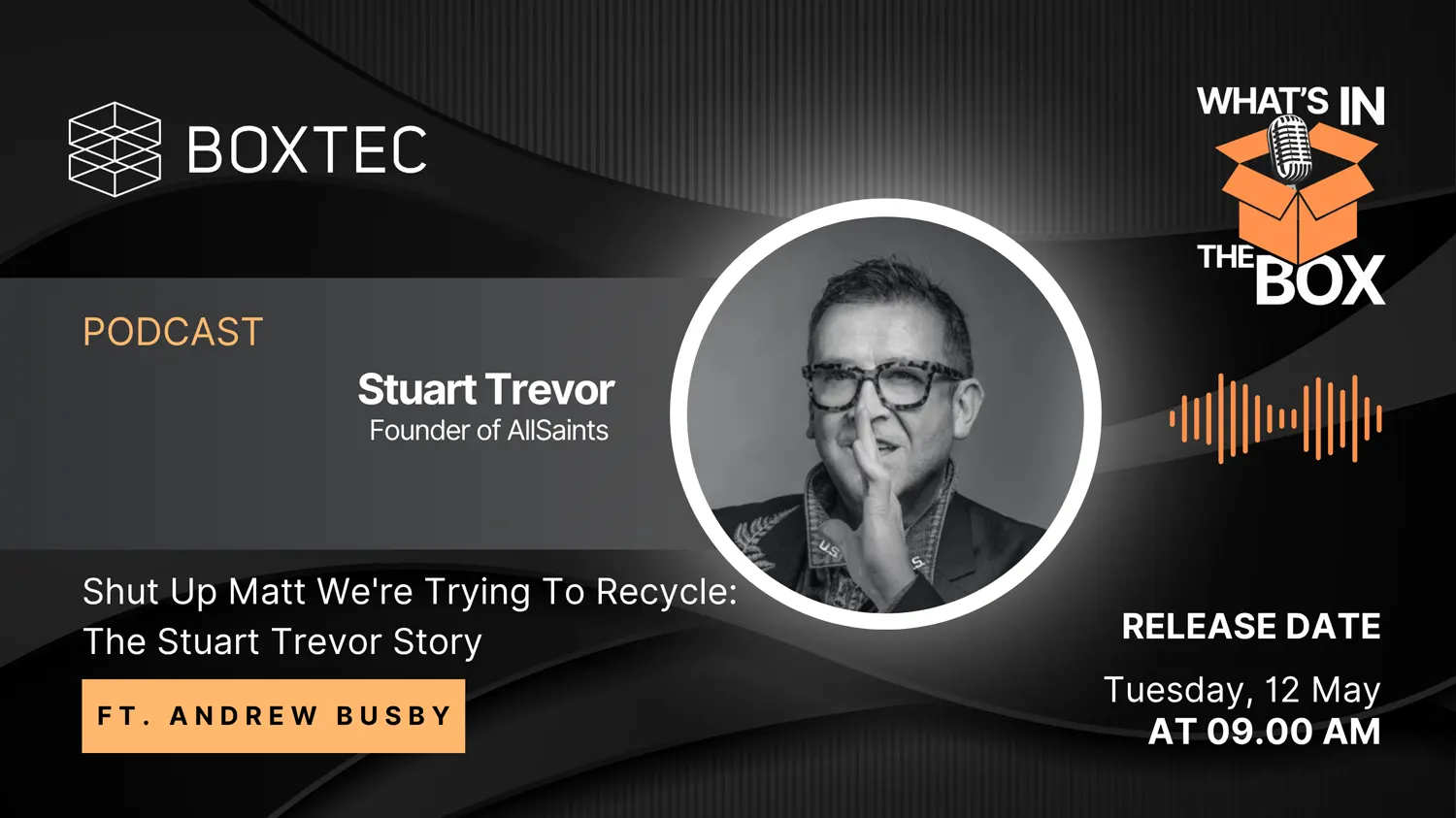
We grab a beer with Stuart Trevor and trace the real path from launching AllSaints to rebuilding fashion out of discarded clothing.
We talk about overproduction, landfill waste, and how signed, dated, personalised pieces can make people care about what they wear again.
• His early fashion wins and years running buying and design before launching AllSaints in 1994
• The original AllSaints vision built on military and biker influences
• The true story behind the iconic wall of sewing machines and how it became early viral retail art
• Why global garment production makes “new” clothing hard to justify
• How upcycling turns old jeans, shirts, bomber jackets, and tailcoats into desirable designer pieces
• What makes the model work online, including repeatable items versus true one-offs
• Signing and dating each piece, adding the buyer’s name, and treating garments like wearable art
• Building loyalty through studio visits, parties, and a shopping experience people want to share
You you follow us on Instagram or at Stuart Trevor Official stuarttrevor.com
Transcript
Host: 00:01
So I’m here at day two, end of day two, even having a beer with none other than Stuart Trevor. Stuart, it’s great to see you. How are you doing? Nice to meet you. You’ve just come off stage, but you very kindly agreed to do this because you and I, I think it’s fair to say that I’ve been trolling you a little on the socials, but what I really want to do is get the real story about your business, Stuart Trevor. But before that, maybe to as a lead up to that, you know, you’re famously the founder of AllSaints, yeah, fantastic brand. Tell us a little bit about that, and then we’re gonna get into Stuart Trevor and what you’re doing now with discarded clothes and so forth.
Stuart Trevor: 00:47
So, yeah, I basically started, I did a degree in fashion in Nottingham, and won the Smirnoff Fashion Awards and a Paul Smith Mont Blanc competition. I ended up working at Reiss, going to join David Reiss, and ended up running buying and design for eight, ten years. And then I launched AllSaints in 1994. While I was at Reiss, when I joined it was a basically a super company. David Reiss, a very classic preppy type guy, chinos, blazer, and I invented all these you know flak jackets, bomber jackets, what they call safari jackets, and really it’s cut a bit more cutting-edge biker jackets. David really couldn’t get his head around it, but it was for bestsellers. He used to call it cheap disco rubbish. I found a a partner who was with a manufacturing company that were willing to fund me doing my own label. I came up with the name AllSaints. My initials are ST, like Simon Templer, the Saint, bought the car that Roger Moore played Simon Templer. Yeah, the Volvo P1800. I still have it, it’s in work right now, it’s getting a total bare metal respray. Yeah, it’s gonna look amazing. I drove that car around from 20 to 35 years old. Everybody used to go, oh, it’s the same, it’s the same. So when I had to launch my own label, I was actually on AllSaints Road, looked up at a few drinks during Carnival, looked up and saw AllSaints. I thought, because I had a list of Mr. Saint, the Saint ST, yeah, and AllSaints. And I asked all the customers that I was selling to, like Selfridges, Harrods, Harvey Nichols, Barney’s New York, Saxville Avenue. Back in those days, you have to sell to department stores at Independent Retail. I asked them what name they loved, and they all loved AllSaints. Yeah. So I registered that name, launched it, created a collection based around a military collection of parkers, bomber jackets, kaghouls, macs, combat pads, made out of nylon, moleskin, and wool flannel. Launched it and sold it. I think at the first season we sold one and a half million pounds worth of clothes. That’s 30 years ago.
Host: 03:10
About 10, 15 million pounds worth of orders. What was the idea to sell it which is kind of iconic, all the sewing machines?
Stuart Trevor: 03:20
I was in a factory in India and I asked that they showed me and presented me a range of clothing that I’ve designed and flown out to check on, and I wanted to check the factory and make sure there was no impropriety. And we walked into the hallway and there was all these machines dumped on top of each other in the hallway. The factory owner was like, I’m like, what’s that? What’s that? And he’s like, please don’t look at these. I have all the latest Japanese machinery in here. And I went, Well, what are you doing with them? And he was like, they’re going to the dump. So I bought 150 of them, shipped them back to London, and we created a wall of sewing machines. In the beginning, it was to fill a void where there was two floors in the store, that we needed a blank wall. We wanted to create work of art. It was around the period of launch of Instagram, and it became like one of the first ever Instagram viral content. So everybody wants to photograph in front of this work of art, and that just became like a huge, huge thing. When I sold the business, the guy that bought it from me employed his brother to run around the world buying sewing machines.
Host: 04:30
Well, I was going to say, I mean, I can’t remember how many stores you had, how many stores where you got to fill the window with sewing machines? That must be an awful lot.
Stuart Trevor: 04:35
Well, when I sold the company, there were 13.
Stuart Trevor: 04:44
They launched another 10 within a three or four year period. Apparently, the figure is since I found recently that apparently 18,000 machines they found. And people laugh and go, well, where do they all come from? My mum and my gran both had a singer sewing machine. Virtually every house in England had one back in the day. But in India, every single house did have a singer sewing machine. And of course, you know, 30 years ago, everyone started buying new electronic machinery. And these other machines became obsolete, so there were millions to go around. So it wasn’t, and nobody could believe how many machines there were, but it wasn’t that difficult, they weren’t that hard to buy.
Host: 05:32
Let’s move on now. Your latest business Stuart Trevor. Tell us about that Because I think most people would know that this is basically taking what would be clothes that are probably going to go to landfill, yeah, and maybe offcuts. I don’t know, tell us all about that. But you’re creating new clothes from that. And I know that you are passionate about this stuff. Yeah, people can go on your website and you go into the fact that you know we’ve all got enough stuff, enough clothes, and I think you quote a figure on there. Is it something like a hundred billion, a hundred and fifty billion garments a year in production?
Stuart Trevor: 06:15
And that’s enough for 40 garments for every human being on the planet. We don’t need to produce another item of clothing for eight to ten generations. We could go without. So what we try and do is we take existing clothes and we make them cool. This young lady’s got a pair of jeans made from two pairs of jeans cut up and put together. I don’t need to, I don’t think we ever need to make another pair of jeans. I can get hold of tomorrow 10,000 pairs of Levi’s in grade A conditions. I can get 10,000 pairs of lean in grade A conditions, yeah. 10,000 pairs of Wrangler in grade A condition. If you want to go into grade B and C where they’re all full of holes or full of bits, I don’t mind that as well, because people like fucked up things.
Host: 07:04
That’s the voice of God. Is that Matt Bradley? Yeah, that’s Matt Bradley. Shut up, Matt. Alright, Matt. It doesn’t matter. I know he knows we’re recording a podcast.
Host: 07:21
It doesn’t matter. Shut up, Matt! You’ll know far more about this than I’ve researching this. We know that the Atacama Desert, as an example, has thousands, tens of thousands of tonnes and also Ghana, but quite a few of them have still got the label on. Yes, they’re brand new. Yes. So tell us about you know your passion, your journey in terms of trying to wean, I guess, mainly the West, off constantly buying new clothes.
Stuart Trevor: 07:51
Well, we wanted to prove that you can create a designer collection out of other people’s waste, and we did that two and a half years ago. Since then, we’ve turned it into a business that we’re now a million, a million run rate, so that’s a million pounds a year turnover. We have every Monday we come in, there’s about a hundred orders that we need to fulfill. Often I have to run around and find them because we take like a plain black shirt or a plain denim shirt, and we cut the back out, and we add some beaded fabric or you know, some dead stock sort of stuff. We take bomber jackets and we add patches to them. We take things like vintage tailcoat, and we added a little Korean military police sort of badge, embroidered badge onto it. We put them online, and the guy that runs my digital said to me, Can you get more of these? I thought he meant one or two, yeah. And I went, Yeah, and he put them online, and that weekend we sold 50. So I had to go online and contact all wedding shops, hire shops, and you know, Moss Bros, try and get hold of all their old tailcoats, and we got them. We’ve now sold about 300 of them, and people love it because you know the one thing that we’re never gonna do is we’re never gonna stop people from buying clothes. Yeah, if you’re if you have a daughter or a son or a wife or husband or whatever, and their birthday’s coming up and the Christmas coming up, what do you want? Everybody wants to look good nowadays, even nerds like you know, Steve Jobs or whatever that created Apple is a nerd, but he created a look and he had Isimiaki design the turtleneck and Mark Zuckerberg, he wears a hoodie and all they have a specific look. Even the most unfashionable people know that clothes maketh the man, and so what you get up in the morning and what you put on will define your day.
Host: 09:40
So, this bomber jacket you’re wearing now. Yeah. One thing that fascinated me, because of the nature of it, are they all bespoke? So how do you do that?
Stuart Trevor: 09:52
But you mean you handmade them? These are dead stock, right? Okay, they’re early 2000s. Yep, there’s a warehouse that we go to that have, and we were running out of sizes and different things like that, but we just go online. Yeah, the difference between a medium and a large and an extra large and a double XL. Some kids like them oversized anyway. So, you know, if it’s not available in a large, then they have to buy XL or a medium or whatever. Yeah, but we can get hold of stuff, we add the patches, we don’t hold huge amounts of stock of anything, so we do virtually tailor it to the customer. We do make a bit of backup stock. If we have a beautiful studio showroom in Toxteth, just north of Shoreditch. Yeah, we invite people to come there and visit and do a bit of shopping.
Stuart Trevor: 10:36
We put drinks events on, and we have bands coming and playing. And so we had a Valentine’s, a Valentine’s Day party, we have an Easter party, we have a Halloween party, we have a summer party where we put a backdrop outside. We have a professional photographer, you can come with your wife, your kids, and you can they can be a model for the day, or you can be a model for the day, come and select something, and you can try things on and buy stuff. So we try and create an experience that people love to come shopping because it’s not all. I mean, we 99% of what we do is online, but some people love to come and visit and try stuff on, and you’ll find things in our studio that we don’t have time to put on. Like, we can’t spend all day putting one-offs online. Yeah, we need to have things like these bomber jackets. We’ve probably now sold two or three hundred of them because there’s backup, but it means that I take a picture of one and then I have a model wearing it, and we can sell 50, 60, 100 of them. That’s the only way you’re ever gonna build a business like this.
Host: 11:38
Yeah, and presumably people like you know these clothes because they are by nature very different. Yeah, yeah, you’re not gonna go down the high street to any other retail fashion. Well, it’s not mass produced.
Stuart Trevor: 11:50
And it’s and people then care about it. And every single piece has a little white label on it that I sign and date, and if you buy it, your name goes on it, you’re the model. And yeah, and it’s – people love that. My daughter came up with the idea, she said, Dad, if you sign and date these pieces, if Malcolm McLaren and Vivian Westwood had done that when they invented punk in 1979 those garments would sell for 10, 20,000 pounds. They could they sell for a million now. Yeah, they had signed them, yeah, um, you know, now that they’ve gone. So we wanted to create that same sort of every piece is like a walking work of art, and people love it.
Host: 12:32
And you find that your customers have I’d imagine that your customers are very loyal to the brand.
Stuart Trevor: 12:38
Yeah, 50% of them are repeat customers, yeah, probably more than that. We do the analytics, and it is yeah, it’s really important that because you know, customer acquisitions, yeah, the hardest thing. Yeah, yeah. So we do if you follow us on Instagram at Stuart Trevor Official, I do these little walkthrough videos where you come out of Old Street Tube and walk seven, eight minutes to my studio, past my favourite pub, my favourite cafe, and then knock on the door and come inside. It’s a like an Aladdin’s cave.
Host: 13:09
I’m gonna have to do that.
Stuart Trevor: 13:10
Yeah, you’ll have to do it.
Host: 13:12
Definitely come and sort it out. That’s absolutely fantastic. Not gonna keep you any longer because I think they’re trying to kick us out anyway. In terms of you mentioned Instagram there, in terms of the website, where can people find that?
Stuart Trevor: 13:25
Oh, stuarttrevor.com
Host: 13:28
Stuart, that’s brilliant, thank you so much. Really interesting to learn.
Stuart Trevor: 13:39
Hold on, the bouncer’s got a hold of me by the collar. Oh gentlemen, there’s two of them that fucking throw me out of it.
Host: 13:41
We’ll just blame Matt Bradley.
Stuart Trevor: 13:43
Hold on a minute, I’m a keynote Host.