Published: 04 Aug 2026
Summary
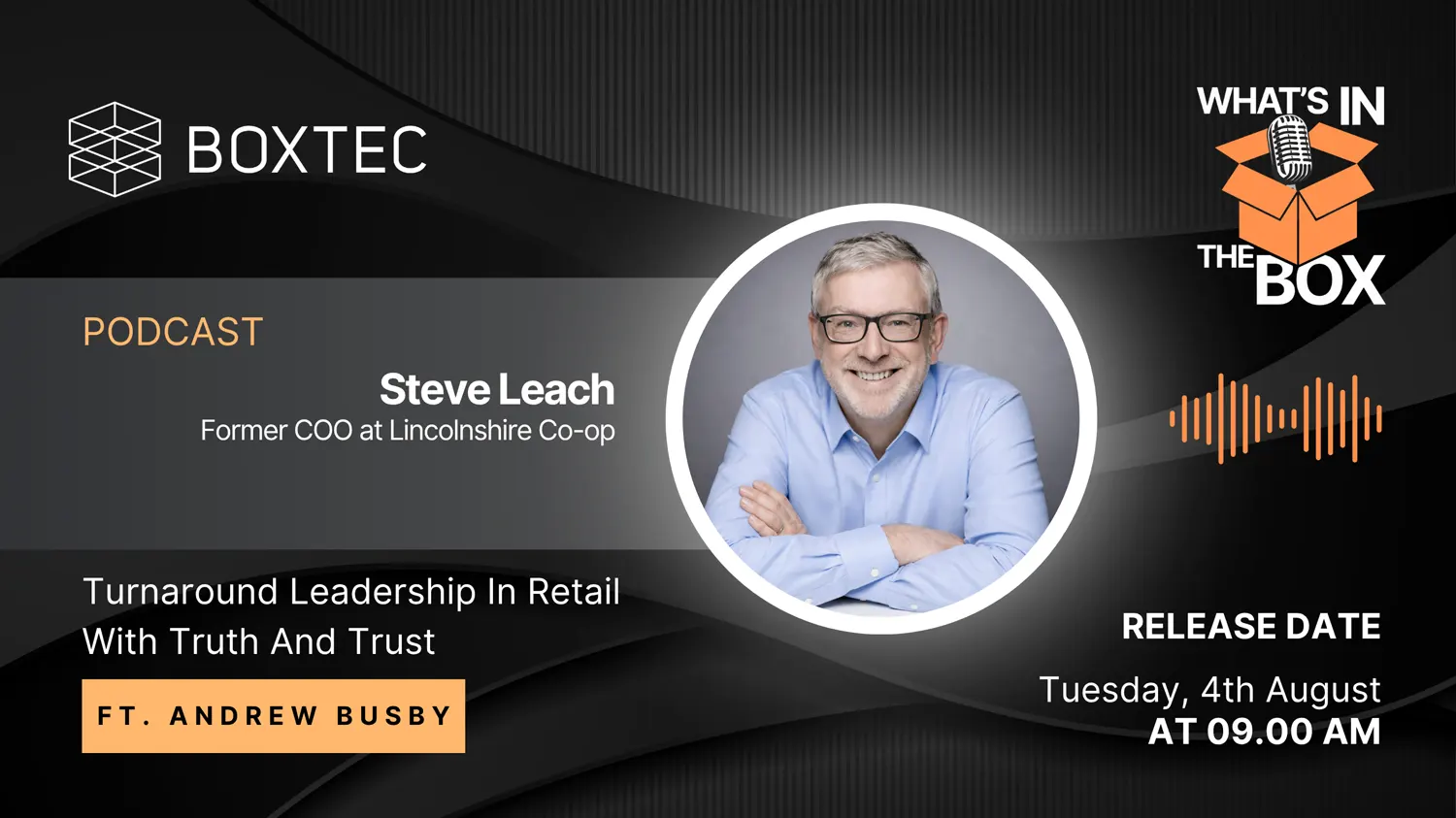
We break down what makes retail turnarounds work in the real world, using a first 90 days playbook, built on truth, trust, traction, and tempo. We also get practical about retail execution, from picking the right KPI to using AI with a clear ROI and keeping changes from slipping back.
- Finding the truth by showing up on the shop floor and seeing reality first-hand
- Closing the gap between stores and the support office through open feedback and access to leaders
- Building trust by explaining the context, the “why”, and what will not change
- Influencing differently in corporate retail versus independent retail environments
- Creating traction with careful quick wins and proof over presentations
- Simplifying performance with one clear KPI such as average basket
- Using AI in retail to remove low-value work and justify change with ROI
- Setting tempo through operating rhythm, cross-functional critical paths, and continuous improvement
New episodes will be dropping every two weeks, so please stay tuned.
Transcript
Host: 00:02
Welcome to What’s in The Box, brought to you by BOXTEC, empowering retail with purpose. BOXTEC delivers innovative and market leading customer engagement solutions that turn business ideas into a performing reality. From design and integration to ongoing support and maintenance, we’re with you every step of the way. Now I’m really pleased to have this particular person on the podcast today. I’ve known him for a good few years, and he’s got fantastic tale-to-tale of some of his experiences at some well known retail businesses and turnaround and so forth. He’s a COO, transformation leader, and executive coach with extensive experience helping organisations improve performance and navigate change. Having held senior leadership roles at Lincolnshire Co-op, Vets Now, Co-op Nisa, and Vodafone, he has led businesses ranging from high growth operations to complex turnarounds and large-scale integrations. He is known for his practical, people-focused approach to leadership and for turning strategy into results. He helps businesses move faster, execute better, and change what isn’t working. Welcome to What’s in The Box, Steve Leach.
Steve Leach: 01:15
Thanks for the invitation, Andrew. Delighted to be here.
Host: 01:18
Thank you. So, yes, as I said in the intro there, we’re going to talk about turnaround and transformation. Maybe they’re two slightly different things, I’m not sure. That seems to be in the news at the moment with one particular quite well known high street chain, which went about a change about a year ago. And sadly, they’re going be closing a number of stores, but hopefully all goes well there. But, tell us a bit about your experience in complex turnarounds and large-scale integration. Tell us a bit about that, and I know you’ve got some examples that you can share.
Steve Leach: 01:59
Thank you. Well, every successful turnaround I’ve had has followed the same pattern, really, about finding the truth, building trust, creating traction, establishing tempo, and getting those things right, the performance will take care of itself. So, the benefit of my background, I guess, is the breadth of retail experience I’ve been lucky to have. So, my last role, I took the first Chief Operating Officer role at Lincoln Co-op. Prior to that, I was interim COO at Vets Now, which was an emergency healthcare business. And before that, I was able to work at Nisa, which was like three jobs in one because that was independent when I joined. It was then acquired by Nisa, so acquired by the Co-op group in 2018, and then went on a very different journey through COVID. And before that, I was retail director at Vodafone. So four very different businesses that have had turnaround and transformation. So when we chatted about what would unite all of those, I thought, you know, how to spend the first 90 days on arrival in each of those would be a good discussion topic for the podcast.
Host: 03:12
Yes, absolutely. Yes, the old 30, 60, 90, I’m sure everybody who’s listening – we’ve all been there. We’ve all put that deck together. Maybe now with the help of AI, I’m not sure. So which way do you want to go? Do you want to go over from Vodafone and bring it up to date with Lincolnshire Co-op, or the other way around? Well, up to you.
Steve Leach: 03:33
Well, I thought what I’d do is go through each of the topics and give you some examples around of each of those, if that works.
Host: 03:41
That’d be brilliant.
Steve Leach: 03:43
So I mean, true truth is really the unfiltered view of reality. It’s, you know, what is really happening. And when you join a business, you can’t do that from behind a desk. You have to be out in front of colleagues and customers, turning up unannounced, moments that matter. So whether that’s the first hour, the last hour, weekends, bank holidays. But in my experience, you really can’t solve a problem that you don’t understand. One of the people who really inspired me to do this was when I was working at Sainsbury’s, Justin King arrived and wrote to every store manager and said that he would make a commitment that he’d meet every store manager within four weeks. Wow. And nobody believed that, but to his credit, within four weeks, he’d done a roadshow around the business, met every store manager, and was hugely impressive in terms of getting people onside through listening. What was very good about that is he got the team of cynical doubters onside very quickly, and what was most impressive is he then summarised the quick wins, what he was going to do, and more impressively, what he wasn’t going to do, and why. So using that inspiration, when I arrived at Lincolnshire Co-op, I had a lot less stores to get around, but I visited all 100 food stores on arrival and so that I could get to know the team, the business, and the trading environment, and that was a really great way of finding out the store estate that I’d inherited and what some of the initiatives were that we’d need to build into the plan.
Host: 05:31
And did you find, because I hear this an awful lot from my days way back with Superdrug, when I visited stores and talked to not just the store managers but the staff, it seemed to me that they really know on the ground what’s going on and how the business is doing. It’s a different perspective, from people in senior roles at head office, but it’s the people in the stores who really seem to know what’s going on. Was that your experience?
Steve Leach: 06:06
That’s always been the case. And the successful retail businesses are the ones that, regardless of size, close the gap between the shop floor and the support office, and make sure that there’s a really open culture of feedback and being able to influence change. I think the most effective retailers that I’ve worked for, and with, have done that very, very well. There’s one of my very strong team members who I work with at Vodafone, Lee Morley, I saw on LinkedIn only this week, is going back to the floor in Sainsbury’s, where she’s now working to try and help the teams through hot weather and build up experience and knowledge, to then take back into the HR agenda at Sainsbury’s. So I think it’s very easy. A lot of retailers talk to doing this, but when you get examples of retail leaders and people from the support offices that do that regularly, it makes a massive difference.
Host: 07:06
I’ll tell you what, if she goes, this isn’t just Sainsbury’s, it’s affected everybody in the really hot weather last week, and we’re recording this episode in the first week of July. We’re kind of in between heat waves, but one thing that became very apparent, which I’m sure you would know the reason for, is that most of the chiller units were shut down. And I read that that’s basically because the compressors that drive them, which are outside, just overheat because they’re working overtime. So maybe this is something that is going to continue getting mid-30s every summer, then maybe we need to have a look at that.
Steve Leach: 07:46
I think this is a challenge that’s as old as time, that one in terms of having old refrigeration units that have to cope with heat waves, it’s really challenging. But equally, it’s also important to point out it’s shop kind week that’s been sponsored by the Association of Convenience Stores and Retail Trust. And I think it’s a really good example where the colleagues working in the stores that are customer facing aren’t accountable for keeping refrigeration going, but they bear the brunt of everybody’s frustration if they want to deal with all the disruption that has resulted. So I think that’s a really that’s a really good example of truth. If you walk into a food retailer and there are challenges around refrigeration, you need that unfiltered view of reality, and I guess be really clear about what then can be done as a direct result. I think the first 90 days is really getting that view. You can’t solve a problem that you don’t understand, and seeing it for yourself in front of colleagues that deal with customers every day is equally the most important.
Host: 08:54
And those four businesses using your truth, trust, traction, and tempo, we’ll come onto those. We’re using those four businesses as examples. Did you find that when you walked in the first 90 days and tried getting your head around what the challenges were, were they all very different, or did you see a theme emerging which could be applied to all four of those very different businesses?
Steve Leach: 09:24
I think it’s a really good point, because each of the four were very different businesses in different sectors. I think the thing that unites them was around the communication of where the business was up to at that point in time, and it fits in nicely into the trust piece because in every turnaround, the trust is a currency that buys change, and the success of being able to get in there. So you need to understand the truth. Getting people onside is much harder because they need to understand the context and what your role as a senior leader is in that organisation. So, a really good example when I arrived at Nisa, I had a very corporate background before I arrived at Nisa, which is clearly a very different business. It’s a delivered wholesaler supplying 1200 independent retailers, and the key thing I needed to do was get the corporate retailers onside. But that was a very different approach to that, with different influencing styles. Because if you’re in a corporate retailer, it’s very direct. Independent retail is indirect influence, and you can’t tell an independent entrepreneur what to do because it’s their business. So what you really need to do is get them onside by how you could add value to them through cutting out costs, selling more, or ultimately driving profit. So I think your influence and ability when you move organisations and sectors is really key.
Host: 11:05
Yes. Okay, so let’s move on to traction. Tell us about that.
Steve Leach: 11:16
Well, traction is really about how you prove that we’re making progress. So that’s the classic early visible momentum and quick wins that you’re able to deliver. And this has to be done very carefully because you don’t want to overcommit in a new organisation and set yourself up to fail. So this is around, in my view, momentum created by evidence, not presentations. It’s the classic, don’t tell me you’re funny, tell me a joke. You have to prove that you can come good on something when you land. And a good example of this was my time at Vets Now as an interim COO. The contacts there, there’d just been a big organisational change, a significant reduction in headcount, and we were just about to get into the peak summer trading period. So the traction there that I was able to lead was around the operating model. The number one focus for me was supporting the business on salary controls, resourcing, and ensuring that the clinics could stay open during the peak period. So that it was really clear that despite all of the uncertainty around the reorganisation, the status quo needed to be protected. And my number one focus there to get everybody onside was to bring my expertise into salary planning and making sure that we had the right colleagues in at the right place at the right time. It’s the oldest cliche in retail, whether it’s a clinic or a supermarket. But actually that was really making sure everybody knew their role in that, and was able to clarify the accountability was really good. So I think without oversimplifying it, in a new organisation, as a new leader, you’ve just got to share what good looks like and make sure that everybody can understand how you’re then going to measure that. Similarly, in Lincolnshire Co-op, I used one KPI to get the food business moving, which was the average basket, because average basket transaction is a great measure because you can use lots of different levers to pull. But ultimately, if you’re concerned about declining footfall, if one extra item goes in the basket from a food perspective point of view, you can do really well from a sales point of view. And we delivered 9% growth in food in the first year of Lincolnshire Co-op by getting everybody united behind one KPI and making that really a consistent focus of the food team. So I think it’s having a really clear view what the quick win is, but not overcomplicating it.
Host: 13:53
Yes. Because we could do a whole separate podcast on retail KPIs. It feels I’m being a touch cynical, that there’s a number out there that are probably passed their sell-by date, and maybe we need to start using AI to have some more relevant KPIs in the industry.
Steve Leach: 14:17
Well, I think AI is going to change the game because what would have taken a large number of people, a large amount of time, can be done at a touch of a button now, and there are many great businesses that are using AI very cleverly. And you can see, I think M&S in their transformation have put AI into the hands of every store colleague, and are taking out a lot of non-value added activity to tailor their task and category management. And I think it’s terrific. I started my career at M&S, and they wouldn’t have been famous for traction. They didn’t even accept credit cards or open Sundays when I arrived, albeit that might be predating my career somewhat. The transformation that Stuart Machin and the M&S team are doing is really, really impressive, actually. And I think you’re right, AI will be able to do that very consistently and very well.
Host: 15:08
And I also saw, I think it was earlier this week that Rami and his team up in Morrison’s are saying that they’ve taken out something just a shade over 900 million by using AI. I didn’t read the detail of where that’s come from, but I guess it’s going to be similar to that example you just said with M&S.
Steve Leach: 15:28
Yes. I think understandably there’s a lot of colleagues that are very concerned around job security, but equally there was a really good case study I read recently where IKEA had taken a lot of colleagues out of their stores but had retrained them all into interior designers. So, actually that’s a fantastic example which benefits the business because they were able to re-train colleagues into selling more IKEA products and convert their skill and expertise and loyalty to IKEA by doing that. And I think the world needs more positive stories about AI that we can demonstrate to the cynical, and to those people that are concerned about security, where they should be maybe a little bit more open-minded. It’s definitely here to stay, but I think we need some more good case studies like that.
Host: 16:21
Yes, and just quickly on that. I still haven’t found my place with AI, and I do adopt this very cynical, you know, it hallucinates, and we know might have bias and doesn’t understand the concept of jeopardy, and maybe it will, and that’ll be a frightening point. But you and I are both old enough to remember pre-internet days, even pre-email. And of course, we were all sold this nirvana, fantastic, oh, we’re all going to have more leisure time because it’s going to be email and all the rest of it. And of course, the complete opposite happened. And I always just wonder whether we’re going to see a similar thing with AI, because we’re very early in the journey still.
Steve Leach: 17:11
Yes, absolutely, and you’re right. I can remember my first mobile phone and what job I was doing, thinking that was going to change my life, and email. What’s the line about emails, if you don’t look after them and feed them well enough, they’ll turn into a meeting. It’s a real challenge, and yes, I agree. So, actually I think from an AI perspective, the early adopters are really demonstrating within retail how to get traction and tempo and the case studies within there. I think the way to get a Chief Operating Officer or a CEO energised about it is by putting the ROI against it. So whether it’s Morrison’s or IKEA, I think there are more case studies now which are helpful because they can put a yes, there’s going to be a cost investment in this, but the payback quite often can be in months, not years now. And if you put a pound note saving against it, if it unlocks greater saving within a Profit and Loss, that’s the way to get traction. And I think that the tempo, just to finish off, is really the how do you make the improvements stick?
Steve Leach: 18:18
How do you get an operating rhythm whereby you can sustain and continue the improvements that you’ve made? I mean, turnarounds don’t fail because people can’t change, they fail because organisations go back to their old habits, or they’re not consistently challenged. I mean, there’s a really good case study with what’s happened at Next, under Lord Wolfson, who’s consistently focused on continuous improvement, store design, stock management, the multi-channel journey, and you know, Next have outperformed the retail stocks, and the share price, have consistently gone on. I don’t think Next gets the column inches as much these days that they deserve, given how they’ve protected their share in clothing and moved ahead of the curve from an omni-channel point of view. So again, my examples for that around operating rhythm is using specific examples. I think it tends to be quite often in businesses cross-functional initiatives that can be a real saving. So when I arrived at Lincolnshire Co-op, we had a very ambitious program of store opening, but we didn’t really have a program and a critical path that united each of the different component parts of the business to perform as well as they could. Again, easily fixed. So the learnings there, the tricks on the first store opening, we weren’t as necessarily joined up as we could be. But by the time we’d opened the second store on my watch, we were able to have a cross-functional team. We had a critical path. Everybody knew what their role was in delivering the success, and we embraced an opportunity of continuous improvement, and that really helped. So I think that is really just making sure that the improvements that you’ve identified then stick for longevity.
Host: 20:13
Yes. I wanted to ask you in all those businesses did you find you encountered it again, it’s kind of a little bit of a retail cliche, but the relationship between head office, or as you said earlier, or support centre, which I think more enlightened people refer to them as, but that relationship in the support centre, the centre and the field, the store estate. Certainly in my day in retail, it was a command and control parent-child relationship. Did you find that in any of those businesses, or in your experience, that is now maturing and becoming far more of a collaborative relationship?
Steve Leach: 21:03
I think it’s improving, but in any business, you’ll always get the them and us culture between whoever’s on the shop floor and the support office. And the only times that will really change for the better is when the guys who are in the stores will get regular access to the senior leaders in whatever organisation. And can see and trust that the values have been role modelled, that they understand why the business is going in the direction that it is, and get regular access to the organisation so it doesn’t feel hierarchical. In every business that I’ve worked in, all my retail career, there’s always been those challenges. But I think the opportunity is about visible access to great leaders. I mean it’s an old phrase, but Tom Peters’ line about management by walking about is as relevant in 2026 as it was when it was first written down. I think it’s a good point. I think the biggest one-word connection under all of this is the why. Do the people who are serving customers understand why the business is doing what it is, in the way that it is, and if they can do and understand their role in it, then I think you’ve landed a great transformation if you’re able to lead over that sort of claim to fame.
Host: 22:25
That is a great place to end on. Steve, it’s been an absolute pleasure. Thank you so much. So that’s all from What’s in The Box for now. New episodes will be dropping every two weeks, so please stay tuned. But thanks so much for listening, and thank you, Steve Leach.