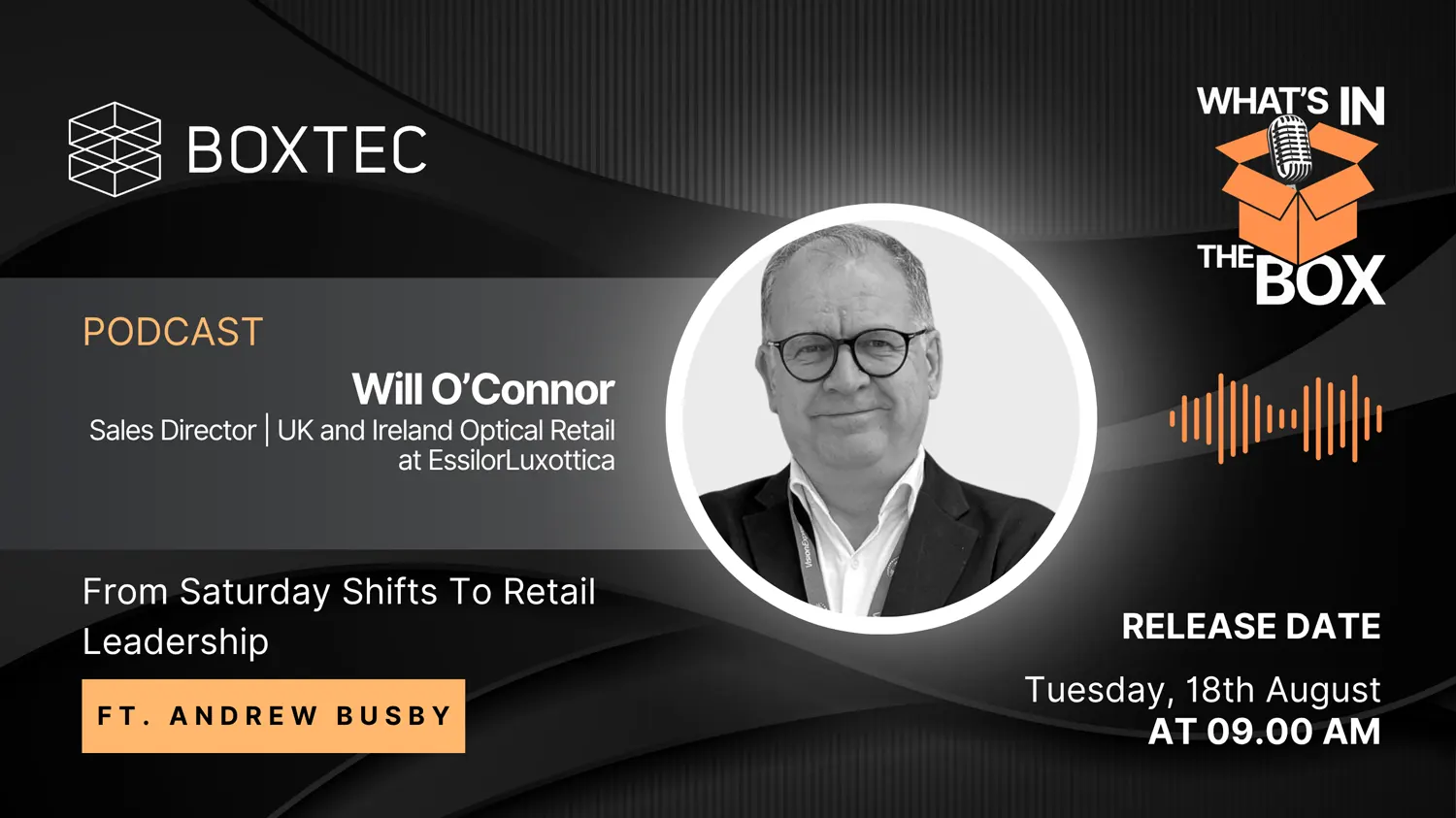
Published: 18 Aug 2026
Summary
We sit down with Will O’Connor to trace a four-decade retail journey from early Saturday jobs to leading a 600-store optician network across the UK and Ireland. We also dig into why retail remains one of the best training grounds for work skills and why healthcare services like opticians may be central to the future of the high street.
- Early retail memories and the “rhythm” of stores
- Why retail builds communication, teamwork, responsibility, and confidence
- The case for retail as a long-term career with clear progression
- What makes optical retail unique: clinical care plus fashion brands
- The customer’s sense of vulnerability and the value of human service
- How e-commerce reshapes town centers and shopping malls
- Why healthcare retail is growing as other space contracts
New episodes will be dropping every two weeks, so please stay tuned.
Transcript
Host: 00:02
Welcome to What’s in the Box, brought to you by BOXTEC, powering retail with purpose. BOXTEC delivers innovative and market leading customer engagement solutions that turn business ideas into a performing reality. From design and integration to ongoing support and maintenance, we’re with you every step of the way. Now, our guest today is sales director at Vision Express and David Clulow. And I think the group should mention is EssilorLuxottica, and I hope I have the pronunciation of that correct, but my guest will certainly put me right if I didn’t. So he began his retail career aged 15 as a Saturday assistant at Olympus Sports. For our older listeners, you’ll remember Olympus Sports, and has spent his working life in the retail industry. He built a 22-year career at Marks & Spencer before moving into senior leadership roles at the Body Shop and later within EssilorLuxottica’s optical retail businesses. Now Sales Director for Vision Express and David Clulow across the UK and Ireland. He leads a 600-store network focused on performance, customer experience, and developing high-performing teams. Having grown up in retail, he believes passionately about the industry and creating environments where colleagues feel supported, valued, and able to thrive. He is also proud to be an ambassador for the Retail Trust and to champion the well-being of people working across the retail sector. Please welcome to What’s in the Box, Will O’Connor.
Will O’Connor: 01:40
Thank you very much, Andrew. It’s very good to be here. I’m a podcast debutant, so I’m really looking forward to speaking.
Host: 01:47
Now, before we go any further, go on, correct me on my pronunciation, please. I’ve got the Luxottica part, right?
Will O’Connor: 01:56
But yes, Luxottica is easier because Italian, I think, for Brits or English speakers are phonetic language. I think we tend to keep it simple by just saying E L. But as EssilorLuxottica, it’s complicated when you’ve got a French name and an Italian name compounded together, but EssilorLuxottica, I think.
Host: 02:16
EssilorLuxottica, right. Good. Easy for me to say. So I mentioned there in the introduction that you started your retail journey a little while ago, I have to say, at Olympus.
Will O’Connor: 02:28
I celebrated my 40th anniversary last month of my first ever job in our in our wonderful industry. Thank you.
Host: 02:35
Yes. Actually, I started I usually say to people it started when I was at Superdrug at 99.
Will O’Connor: 02:42
Okay.
Host: 02:42
But actually it started quite a way before that. Beales department store in Bournemouth.
Will O’Connor: 02:46
Okay, yes, I remember, of course.
Host: 02:48
And before that, just before that, a Saturday job, also in Bournemouth, at a music store, Minns Music, they had a few branches around Bournemouth and Boscombe. So you go in there on a Saturday and just play around with the guitars and all vinyl.
Will O’Connor: 03:09
Yes, not vinyl in your record store, I would have thought.
Host: 03:11
Oh no, it was a musical instrument.
Will O’Connor: 03:13
Oh, yes. Musical instruments, I got to go to the music.
Host: 03:15
Yes, guitar. So you’d have a play with the instruments when people work in. But anyway, let’s talk first about retail because I know you’re passionate about the industry and helping people in it. And also healthcare on the high street. But before we get into that, your start at Olympus Sports, what can you recall about that and about those days in retail?
Will O’Connor: 03:46
I think I had a bit of retail in the blood because my mum worked originally, I think, for M&S in her late teens, going way back. But do you remember the days when the government, believe it or not, had industrial training boards? So the government would take responsibility for training people in industry. And there was a retail training board called the DITB, the Distributive Industry Training Board. And for all of my childhood, my mum worked for the DITB, so she would go and deliver training in retailers. That would have been in the 70s and 80s. So I think I grew up kind of playing shops, as well as playing football and cricket, playing shops at home, and I was very excited. I just probably turned my 15th birthday and I decided I wanted to go and get a job. I lived in Epsom in Surrey, as you said, and I applied to a number of retailers. My heart was set on M&S because I knew M&S had the best hourly rate, and I also knew that they sold off all the out-of-life food at the end of the day at 50% off. I applied to M&S. I had an interview, but I was told I was too young because I’d just turned 15. I got a lot of rejection letters back, but I was strangely thrilled with all these rejection letters because really, for the first time in my life, I had my name printed, this headed paper from the likes of Boots and John Menzies and all these retailers, and they rejected me, but I was pleased with the letters anyway. But, Olympus gave me an interview, and I remember starting there very clearly. My first day in our industry was a Thursday late night in July 1986, and I can remember stepping out onto the shop floor and having really no idea at that point that I was suddenly part of the production. You know, I was part of the organisation. I worked for this, I represented this company, and people expected me to know things and have information. And I was pretty thin on information that first night. But I thoroughly enjoyed my year at Olympus Sport. I learned, I suppose, I gained my passion for product and working with customers, and what I love about our industry is it’s like a river that never stops flowing. You know, the lorries are driving through the night, people are arriving in the food retailers starting at the “crack of sparrows” in the morning, and of course, these big out-of-town shopping malls, they trade so late, they almost go around the other side, don’t they? So I kind of loved the rhythm of retail right from the beginning. But then I did apply for M&S, and I was very glad at the age of 16 that I got a job there with that great hourly rate. I think it was £1.67 an hour when I started, and all of those 50% off Cornish pasties and freshly squeezed orange juice that I suddenly could access on a Saturday night.
Host: 06:15
So tell us about that journey at M&S, because we do hear a lot about the fact that retail is probably one of the few, if not the only industry, where you can literally start on the shop floor and work your way up into the boardroom, if you like.
Will O’Connor: 06:33
Exactly right. And that’s I think one of the exciting things about our industry, isn’t it? You it will be difficult to rock up with a hospital and take a job as a cleaner and end up as a surgeon or at the law courts as a receptionist and end up as the judge, but you genuinely can rock up in a retail business as a youngster, or a not so youngster, and there is really nothing that would stop you getting to the top if you’ve got a bit of brain power, and probably more importantly, some endeavour and a work ethic. But you know, I actually took my O-level options, Andrew, because I’m old enough to have done O-levels on the basis of joining the RAF as a pilot, but my eyesight soon did for that. That was the only reason I did physics at O-level. And then I took my A-level options on the basis of being a barrister, I was going to be a lawyer. But that was all swept aside for two big reasons at M&S. I met a woman and fell in love, and 32 years on from our marriage, she’s still my wife, and she was a young management trainee for Marks & Spencer. But I fell in love with the business as well. I fell in love with this extraordinary organisation. I’m biased, I’ve got kind of green M&S blood running through my veins still to this day, but you know, probably right up there with being one of the greatest, if not the greatest, sort of retail schools and retail businesses in the world at that time. And yes, it was infectious again. I loved the product, I worked on food, I worked in the menswear department, and I realised M&S had a A-level training programme, so my university plans were torn asunder by my ambition to join M&S. And I did my two years as a “Sassy Boy”, which was great, and then I started on September the 11th, 1989, as a management trainee in the Romford store. Funnily enough, exactly the same day that Simon Roberts, who’s now running Sainsbury’s, started. Simon and I grew up in the business in those early days together. So, yes, that was my journey from the shop floor, I suppose, into having one, I think I had one counter of men’s trousers to look after, on the first floor in Romford back in September 1989. And once I’d mastered that, they gave me a second one.
Host: 08:38
Who was running M&S? Was this pre-Stuart Rose?
Will O’Connor: 08:44
Yes, well before Stuart. So a guy called Sir Richard Greenbury, I’m not sure whether he was Sir by that point. Rick Greenbury to Sir Richard Greenbury was the chairman and CEO, a man called Lord Rayner had had recently stood down as Chairman, and yes, you know, when you’re a kid in the business, you look up at these people and they are the retail gods, aren’t they? And I don’t know, maybe I’m getting old and nostalgic, but I’m not sure they quite exist in the same way these days.
Host: 09:12
Oh, I don’t know. I mean it’s funny, isn’t it, that the CEOs of some of these big retailers I think are still held in pretty much in high esteem aren’t they?
Will O’Connor: 09:24
Of course, exactly right, but I suppose when you’re an 18-year-old and you had one of the grown-ups come into the store, it was very inspiring in many ways because that illustrated that there was a route to a great career and a great working life, and that’s certainly what I’ve enjoyed. I’m I continue to love every minute of it along with it’s my third great sort of sports passion, football, cricket, and retail. Somebody said to me recently, if I wasn’t paid to do it, I’d probably do it for free. Don’t tell my employer that. But, I love our industry so much. I enjoy every moment I spend in stores and on our high streets and shopping malls, and meeting the wonderful people who work in it. So yes, it remains a thrill for me, even into my fifth decade.
Host: 10:15
Wow, well. So on that again, as I said earlier in the intro, that you’re passionate about this, and we read, and we hear a lot at the moment, about retail is a good, valid career for young people, whether they be school leavers or graduates. And we also sadly hear a lot that it’s just a stepping stone to getting a “proper job”. So we get a Saturday job and I think that perhaps it’s viewed as well it’s hard work now, of course, with sadly the increasing number of cases of abuse of retail workers. I think it it’s putting people off. What are your thoughts on that? Do you do you feel that is an accurate perception, and if so, what can the industry do about it?
Will O’Connor: 11:12
Well, I’m certainly firstly a big believer in the merits of young people taking Saturday evening work in retail, if those jobs are available to them. Now, of course, we know that the physical footprint of our industry has contracted a lot over the last 25 years or so, so it’s pretty clear there are fewer of those jobs available than there used to be. But it seems to me that both retail and hospitality are the perfect opportunity for young people to learn some of the really basic skills required to be in the workplace: teamwork, hard work, endeavour, speaking to people, communication, being organised, and you know, many young people will learn responsibility and the value of responsibility in their families growing up, but some won’t necessarily, and we have the privilege to be able to help people acquire those skills when they come and work for us. I also think there’s a lot of self-esteem and benefit for people earning a bit of money that they’ve earned themselves, and having a pay packet at the end of the week, or the end of the month, and giving them a taste for the fruits of some hard work and some endeavour. So it seems to me that our industry is vitally important to allow older kids, I suppose they are teenagers, young people, people in their early twenties, to learn those skills, whether they end up working in retail or hospitality is neither here nor there, really, but it allows them to acquire those skills that are required. And then, as far as the longer-term career options for people, I mean it’s pretty clear, as we both know, that you can make a very fulfilling, enjoyable, rewarding career from working in this industry. And it’s very interesting to me working for both. I was at the Body Shop when we were part of L’Oreal, and we’re now part of EssilorLuxottica, as you as you said, Vision Express and David Clulow are part of that global business. And we are a business that is a retailer. If I think about EL, we have 20,000 stores globally, which is a lot, but we’re also a manufacturer, wholesaler, marketing organisation with famous brands that many people will be very familiar with. And what I find is a lot of my colleagues who come from the marketing, the wholesale side of the business, the manufacturing side of the business, they want to work in the retail business. You know, they are fascinated by and drawn to this direct connection with the customer. It’s a real life business ours. We’re dealing with the direct, the end customer every day, but we’re also I think privileged to work in the town centres, the city centres, these exciting big shopping malls. So I see a lot of people wanting to move over to work in retailing, and I just think it’s a wonderful career option for young people and maybe people who aren’t young people who want a job change, whether you work your way up from store manager or join in a more senior capacity. I often say to people who work in our stores, we don’t have a secret training school for future area managers, regional directors, sales directors, and the MDs, our stores are that training school. So you can join the business in our case as a what we call an optical assistant, so sales assistant level, but there really is no limit to where you can go. And I think that is one of the things that makes our industry wonderful.
Host: 14:41
And presumably with your type of business being in healthcare, and with Vision Express and David Clulow, it’s a very personal service, isn’t it? I mean, we know that retail is a people human industry, that’s well established. But I can imagine that for you, Will, even more so because of the type of service that you are delivering.
Will O’Connor: 15:08
I think that’s exactly right, Andrew. And we care for people when they come to see us. One of our customers will typically spend probably an hour in the store, which is a much longer period of time than they would spend in most retailers. We’re unusual because we’re selling on the one hand all of these famous brands, Ray Ban and Oakley, which are two of the brands that we own as a business, and then we sell Chanel, Prada and Jimmy Chew. And all of these famous fashion brands, all from these extraordinary stores, these fashion houses. And then on the other hand, we’re also a medical business where we employ well over a thousand optometrists and opticians who work in our business every day. So on the one hand, we’re dealing with people’s medical needs, their clinical needs, and we’re selling a highly regulated medical device. On the other hand, we’re selling a fashion lifestyle product which is a very important part of someone’s look, when they put their spectacles or their sunglasses on, or indeed their contact lenses if they don’t want to wear spectacles. That’s a very important part of people’s aesthetic. So the fact that we sell a Ray-Ban medical device or a Chanel medical device is a unique feature of an optical business. But what is true is that you wouldn’t work in our business doing what we do if you didn’t like people, and caring for people wasn’t one of the pleasures of doing what we do. Yes, you’ve got the thrill of hitting the sales targets and the interest in product and that’s the famous buzz that you get from retail, but you also get this, it’s a selfish pleasure in many ways, caring for people. It feels good to look after people, and we do that with many tens of thousands of people every week.
Host: 16:48
Yes, and of course yours is a very going back to the very personal nature of it, we’re seeing more and more examples on the high street, and particularly in grocers, various forms of self-service. Well, that wouldn’t apply, I’m sure, for your businesses. So it has to be that direct, one-to-one engagement.
Will O’Connor: 17:12
It’s a very important part of our of our mission, really, I do believe that retailing is important and good for our society. I believe that our town centres and our shopping malls are an important part of the fabric of our country and the work that we do as retailers is a part of that. And yes, we’re dealing with a particularly intimate personal part of that. When people come to us, they come, you know, we both go to the opticians, we come with a certain sense of vulnerability, don’t you? When you go and sit in the big chair and you put your trust and your faith in the expertise and training of these wonderful people who work across our industry. And it’s a meaningful moment because you want to know the results of the health check that’s carried out are okay, and you want to know whether your prescription has changed and whether you’re going to either get the opportunity to buy a new pair of glasses or you’re going to have to shell out on them, depending on which way you look at it. But what’s true is it’s an important moment for people. You won’t be surprised to hear that I speak to people who say that the hour that they’ve spent with us, and the care that we’ve given them, will have been one of the more meaningful points of contact that they’ve had with people that day. And that’s a very humbling position to be in, and therefore we of course strive as our whole industry does, to look after people as well as we possibly can, and we’re caring not just for their medical needs in respect of their eyes, but I think we’re meeting an important social function as well. I agree with what you said at the beginning.
Host: 18:46
Yes, and how does that translate to the high street? I mean, I live in Sussex in East Grinstead, so fairly typical, relatively small old market town. I was there earlier today and I was walking along the high street and I think East Grinstead is probably fairly typical. All the banks and building societies have shut down and there are still big holes left on the high street. But you see hairdressers, I think East Grinstead has something over 30 of them, but you also see opticians, and I guess that’s because you can’t do that well, some people do it online, we know that, but I’m never really sure whether that that works or not. So you’ve got businesses that that are personal and need to be physical as opposed to online.
Will O’Connor: 20:01
Exactly. And I think if we step back for a moment and take a bigger view of our industry and the role that retailing plays in providing the fabric of town centres, we’ve seen an enormous change, haven’t we. In the period that we’ve been working in our industry, and we probably joined it when bricks and mortar retail was, we maybe didn’t realise at the time, but was coming to the end of something of a golden age. And, I know you’re a big fan of the history of the big department stores, and we can look back to, I suppose, the end of the 19th century, which was about these big department stores. Of course, we know about Selfridges and Harrods in London, but right across the country. Liverpool’s a city I know very well. George Henry Lee, you’ll remember, which became the John Lewis Bainbridge’s in Newcastle, House of Fraser in Glasgow. You mentioned Beales in Bournemouth. I would guess that nearly all of these businesses were born in the 19th century, and then the big chain multiples like Marks & Spencer, and others emerge very strongly in terms of growth between the wars and post-war, and all those famous names, again, many of whom have disappeared, of course. M&S, of course, are still there and going strong, but British Home Stores and Littlewoods and Debenhams, of course. And then we saw shopping malls being opened, the Arndales of this world back in the 1960s before our time, but we know that’s when there was a boom in shopping centres. Then through the 80s and 90s, these huge edge-of-town shopping centres, which are such an important part of the mix today. I can remember Metro opening, Blue Water opening, Lakeside in Thurrock, all of these shopping centres opening, and working in many of them. But then 2000 was a bit of a turning point, wasn’t it? Then we started to realise that with the growth of Amazon, but just e-commerce generally, the high streets and shopping malls acting as almost the stock rooms for people’s consumer goods. Well, that just was not going to be required anymore. And we’ve seen the contraction of bricks and mortar retail. I think with healthcare it is really the counterpoint story to that for exactly the reason that you said. When it comes to healthcare, people need to be physically present. You can’t have an optical or a dental or a hearing aid or a physiotherapy appointment without physically going to a location where those services are dispensed. Much as I’d like to be able to go to the gym, you know, digitally online, without leaving the comfort of my armchair, as I can when I’m shopping, otherwise you’ve got to go. And in our industry, there’s about, I think, 8,000 optician stores in the UK, which is a thousand more than there were 10 years ago. So what we’re seeing is not just opticians, of course, but pharmacy and dental practices. I’ve mentioned gyms, seems to me, I observe Holland and Barrett have a thriving business, which is to a large degree a healthcare business. Boots the pharmacy, the retail business, they have a strong optician’s business, but their business is an ever-present in many of the towns that I go to. Seems to me that not only is healthcare a greater proportion of bricks and mortar retail than it ever has been, but it’s also getting stronger and it’s growing in many of those spaces. And I think that’s very encouraging if we care about our industry and we care about our town centres.
Host: 23:31
Yes, absolutely. We’ve got into an area which is absolutely fascinating. We could talk about it for a lot longer than the 20, 25 minutes we’ve got, but we’re pretty much out of time. So Will O’Connor, thank you so much. That’s been a snapshot, a little look into your world and your retail journey. But that’s all we’ve got time for What’s in the Box for now. New episodes will be dropping every two weeks, so please stay tuned. And if you want to find out more about BOXTEC, please follow the link in the description. Thanks so much to Will O’Connor and thank you for listening. Thank you very much.
Will O’Connor: 24:06
Thank you.