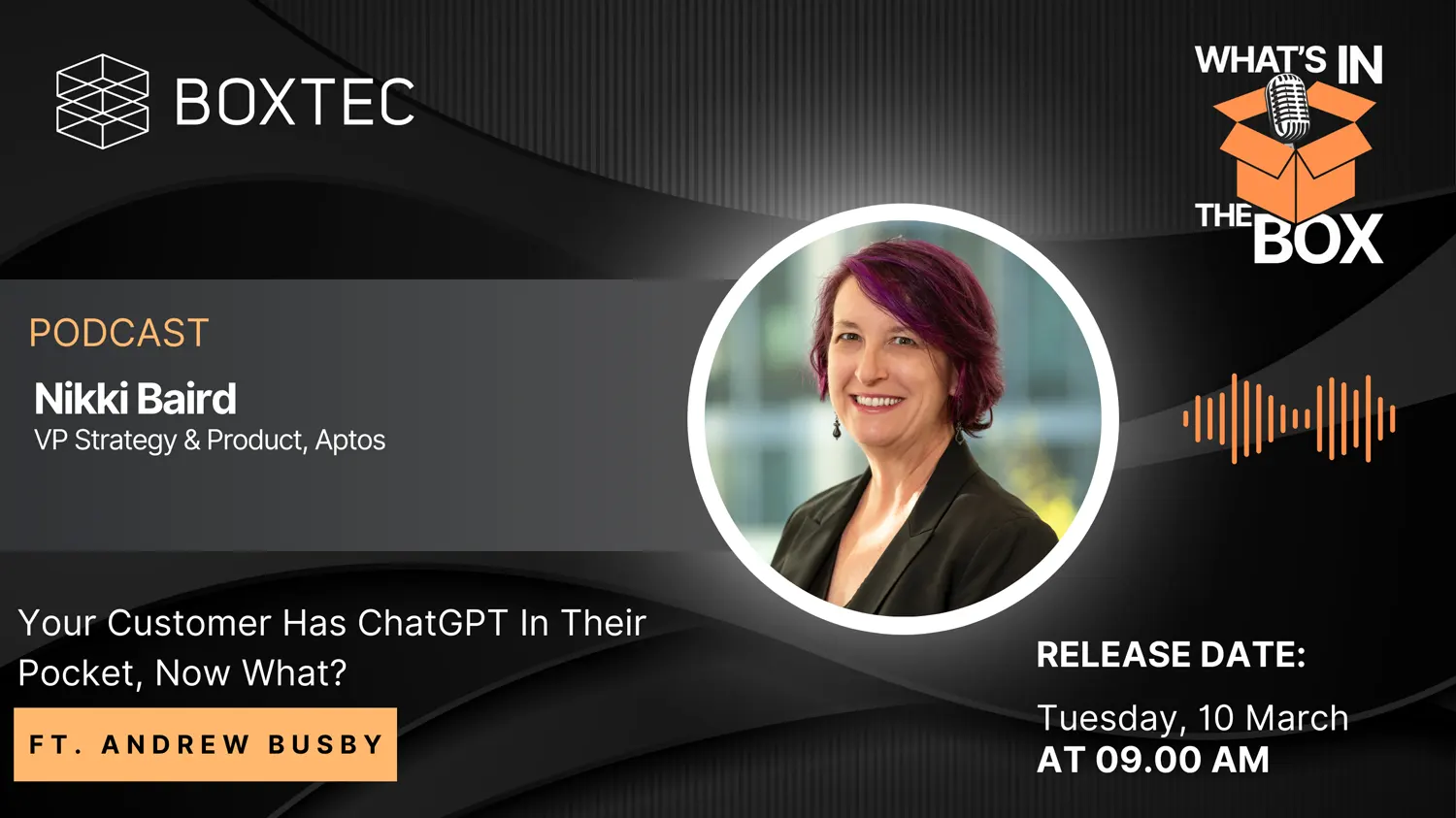
Published: 10 March 2026
Summary
Shoppers are about to bring a new kind of power into your store: an AI co-pilot that compares, recommends, and negotiates in real time. We sit down with Nikki Baird, VP of Strategy and Product at Aptos Retail, to map the shift from Omnichannel to unified to agentic commerce — and what it means when a customer consults Chat GPT while standing at your shelf. The headline: stores still win, but only if we double down on what makes them priceless, and pair it with great data and smarter tools for associates.
We dig into why 2026 could mirror the first smartphone shock to retail, when the four walls no longer protected price or narrative. This time, large language models add a persuasive voice to the shopper’s side, turning “What outfit should I wear to a July wedding in Italy?” into instant cross-retailer advice. Nikki explains how to counter that with the connected store: tactile experiences, sensory design, and community, that online can’t match. All supported by clean, accessible product data and mobile tools that give staff parity with AI-savvy customers. We also unpack NRF’s (National Retail Federation) swing toward pragmatism, where data foundations and access decide how fast AI can truly help.
Trust runs through it all. With loyalty shaken by inflation and digital fatigue, consumers increasingly lean on neutral agents. We explore AEO — Answer Engine Optimisation — so your product data, attributes, and authoritative signals surface well in model responses, not just search results. And we share why younger hires, who grew up using AI, may accelerate cultural adoption on the floor. If you care about retail technology, store experiences, and protecting brand equity in the era of agentic commerce, this conversation offers clear steps and sharp insight.
Transcript
Host: 0:11
Welcome to What’s in the Box, the podcast brought to you by BOXTEC, powering retail with purpose. BOXTEC delivers innovative and market leading customer engagement solutions that turn business ideas into a performing reality. From design and integration to ongoing support and maintenance, we’re with you every step of the way. Now, this podcast is a little different to what you might be used to. It’s audio only, totally unscripted, I promise. And we only run for around about 20 minutes because we’re busy, our guests certainly are, and we’re sure you are too. So let’s get right into it. My guest today is Vice President of Strategy and Product at Aptos Retail. She looks after the future of retail and retail technology and identifies their impacts on both retail and Aptos’s strategy and solutions. She has been a top global retail industry influencer for nearly 20 years with a background in retail and technology and a career-spanning PWC, Forester, Independent Retail, and tech start-ups. I’m delighted to welcome Nikki Baird to What’s in the Box. Welcome, Nikki.
Nikki Baird: 1:25
Thanks. Thanks so much for having me.
Host: 1:28
And thank you so much. I think you said that, well, it’s afternoon here in the UK and you’re coming at me from was it you said Denver, Colorado?
Nikki Baird: 1:38
Denver, yes, seven hours.
Host: 1:41
So, dawn, because I’m English, I’ve got to ask, what’s the weather like?
Nikki Baird: 1:46
It is unseasonably warm. I’ll probably regret telling you because it sounds like it hasn’t been a great weather season for the winter for you guys.
Host: 1:54
No, it’s been wet and continues to be. So whether that’s down to climate change, I wouldn’t like to say. But anyway, so I said in the intro there, these are really only sort of 20 minutes. We don’t go on and on and on. So let’s get into it. Before we get into some of the topics that I want to discuss with you, tell us a little bit about yourself. You know, I said the intro there, but I’m sure there’s more you can tell us, and also in particular about Aptos Retail and what you’re up to at the moment.
Nikki Baird: 2:29
Yes, I’ll start with Aptos and then talk a little bit more about my role within it. So Aptos Retail is an enterprise software company that’s focused 100% on the retail industry. We do the parts of retail that are hard and differentiating. So commerce is a big part of that, and unified commerce has been, I’ll say, the watchword, but it seems like things are changing and agentic commerce is becoming more and more important.
Host: 2:57
So what happened to Omnichannel?
Nikki Baird: 3:00
Yes, oh omnichannel was dead years ago. What are you talking about? Unified commerce came and killed that, and now agentic commerce has knives out for unified commerce. So it’s very interesting times, but really like focusing on connecting customers to products. So the product side of it’s just as important to us as the commerce side. I have, as you may have guessed, been spending a lot of time thinking about what the impact of agentic commerce will be. Like everybody right now is really focused on e-commerce because it is that kind of red alert moment, but for me, it’s all about the store. We look at the world through the lens of the store, and as you well know, the store is extremely important. There’s a lot of pressure on it right now. Not that there wasn’t, for the last 20 years, but I think there’s even more change and pressure and disruption coming, and it makes it an interesting time to serve stores.
Host: 3:58
Okay, so I can’t let you get away with that. Why do you think that is? Because it’s something that I think a lot about, and because the likes of you and I, we’re always being asked, aren’t we? Particularly around about December, January time. Okay, what can we expect in the year to come? And also, what if you had a crystal ball – let’s have a bit of fun – what do you think we’re going be seeing in 2026?
Nikki Baird: 4:22
Yes. In-store, I think what we’ll see is more consumers shopping with Chat GPT open, right? Like if you think back to the first Omnichannel experiences, it was when consumers pulled out mobile phones while they were standing at the shelf and were comparison shopping the retailer while standing in their store. And that really was like in the whole span of omnichannel, I think that was a crystallising moment for a lot of retailers, like, oh crap, the four walls of the store are not safe any longer. I can’t just pretend that my website is a big store. I actually have to deal with integrating across all of these things. And I really feel like 2026 is going be the same kind of crystallising moment, but for the role that LLMs and Generative AI play in the shopping process for consumers. So we’re not at the point where it’s an inflection point in terms of shifting consumer behaviour, but we’re seeing enough change in consumer behaviour. I mean, any new technology for consumers, the first thing they do with it is they ticket shopping. And that also means shopping in the store, too. So I that’s 2026 for me.
Host: 5:43
I love that. So to explore that a little bit more, do you think then that I mean that one of the kind of one of the most common examples of this is, isn’t it, it’s natural language. And let’s say I’m going to a wedding in Italy in July. What sort of outfit would you suggest? And I’m standing in XYZ store, let’s say, okay, it could be, I was going to say Neiman Marcus, but it wouldn’t be now, would it? You know what I mean.
Nikki Baird: 6:19
Yes, definitely. But yes, like when going back to that parallel Omnichannel, you know, at the time we were talking about how consumers had the internet in their pocket. And I think the analogy today is they’re going have a store associate in their pocket, and they’re going to have a store associate that has access to every retailer’s stores and not just yours. And to me, that’s where it’s okay, we’ve dealt with this power imbalance between the consumer and the store associate before. And we still have retailers, right, who are like, oh, I’m not sure if I want to put mobile in my store associate’s hands because I don’t want them to mess around and be playing games and not paying attention to customers and you know, texting their friends or whatever. And it’s like, that’s so done. Like, why are we even having these arguments anymore? But now it’s like, they won’t stand a chance if they don’t have mobile in their hands, and even more, at the very least, give them access to Chat GPT or whatever so they can at least ask the same questions that customers are asking and have some parody. I mean, ideally you’d give them more than that, but at least give them parody because it’s going be a bit of a bug bath, I think.
Host: 7:39
Yes, absolutely. And I’ve personally been spending some time when I get a spare half an hour or so, just you know, playing around. Well, playing around, that’s not the right word. You know what I mean. Well, yes, okay, I’m playing around.
Nikki Baird: 7:55
Yes, yes, yes. Experimenting, learning.
Host: 7:58
Experimenting, yes. But not just with Chat GPT, but with Claude, with Gemini, with Perplexity. But there’s also actually some really interesting, all three government-backed AI online courses. And they’re written by the likes of IBM, Salesforce, Accentra, people like this. So I need to have a look at that because I just think that we’ve got to, you know, all of us, we’ve got to understand what LLMs or AI, agentic AI can do for us. So I put up in a meeting that we had here the other day a quote. It’s the one I found attributed to Gary Kasparov, the former Russian chess master world champion; that AI won’t take your jobs, but it’s people using AI that will take your job. And I really think that that could be become very true.
Nikki Baird: 8:55
Yes, I agree. I mean, we’ve seen some initial transition from some of the companies who originally said, I’m not going hire junior level people because I don’t need them anymore, and AI is going replace them all. And now we’ve got companies like IBM who are saying, no, no, no, I’m going to hire those people because they actually know how to use AI, and integrate it in their lives because they did it to do all their homework in high school. Now I want those people in my company because they’re the ones that culturally will drive more adoption than if you rely on the people who are not using it as a part of their everyday life.
Host: 9:36
Yes, absolutely. And of course, perhaps before we move on, but the interesting thing for me is that Gen Alpha, who, as I understand it, are at the moment up to 15-year-olds, give it a few more years, they’ll be starting to enter the workforce. And the thing is, they’ve never known a world without AI.
Nikki Baird: 9:54
Yes, I totally agree. It’s a giant social experiment to some degree, right? Like whether we want to participate or not, it’s happening.
Host: 10:06
So it’s like we’re all hamsters on the wheel?
Nikki Baird: 10:09
Exactly.
Host: 10:10
Now tell me, I know that we’re quite a few weeks on from NRF (National Retail Forum), but maybe just give us a just a few thoughts on what you thought of the show and perhaps what the main themes for you were that came out of it.
Nikki Baird: 10:30
Yes, it’s actually a good follow-on to the discussion we just had because like last year, everything was agentic, right? It was the shiniest, newest object. Everybody was claiming that they had it. And now I think the theme this year was definitely more pragmatic. Like NRF always has these pendulum swings where they go from the extreme future to the very pragmatic present. And to me, 2026 was more the pragmatic presence. It was like we can’t do all this stuff if we don’t have our data in order. So there was much more talk about what kind of foundations do you really need to have in order to be successful in adopting AI and agentic and all of that. And to me, that was helpful, right? It’s like, we can imagine the future, and that’s awesome and exciting, and that’s half my job, but you have to tie it back to something real. Data becomes very clearly and very quickly the governor, the speed governor, on how fast you can go.
Host: 11:34
Yes, when you say data, and I know that this is it sounds a bit of a cliche, if that’s the right word, it’s got to be good data, hasn’t it? Yes, it has to be quality.
Nikki Baird: 11:45
There has to be a lot of it, and it has to be accessible to AI. So you can have lots of data locked up in SQL databases, but if you can’t get that out into a frame where AI can access and leverage it, then you’ve got nothing. Like that’s the barrier today.
Host: 12:07
Yes. Now, earlier you said, and for both of us, for both you and I, and also Aptos and BOXTEC, we love stores. That’s what we’re about, and so forth. One other thing I just want to ask you about, which I saw that appeared to be one of the themes coming out from NRF. I think they described it as a store, as a digital hub. I kind of refer to it as the connected store where I’m seeing this, we’re bridging the gap, if that’s the right way to term it, between online and physical retail. Was that something that you saw?
Nikki Baird: 12:44
Yes, I think we’re redefining like “fidgetal” and Omnichannel, right? Everybody’s still trying to come up with what the right term is, or the right collection of concepts. And digital hub’s interesting. I think it downplays a bit the value of the physical. Like I’m not willing to give that up because it feels like in real life, the smells, the music, the touch and feel of the things that you’re buying, the sounds of other people, you know, conversing or gossiping, or that looks great, right? Like all of that very high bandwidth perception and interaction, I like that is going be an antidote to an increasingly digital world. So I think I feel like we’re going to see more retailers doubling down on the physical aspects. Yes, you want to collect as much data about what happens in that store as possible. And in that sense, it has to be a digital hub. But I think what you put into that store has to be doubling down on the physical side of things because that is the differentiator of stores. You just can’t get the same experience online, and you never will. You never will. So in the store, it’s got to be physical, it’s got to be community, it’s got to be experience.
Host: 14:15
Yes. There’s an example of this I’ve seen once or twice where luxury, let’s take the luxury sector, and let’s say you’re lucky enough to be in the market to buy a luxury watch and you’re going be spending five, ten thousand dollars on this. Well, you want to feel it on your wrist, don’t you? Because part of a watch of that price is the weight of it. And so you can’t do that online, can you? So I’m sure you’re right. It’s just not the same.
Nikki Baird: 14:50
yes, and I think I think there’s something to be said too. I think what gets lost a lot is people assume that everybody wants buying to be ultra convenient. And I don’t think that’s true either. If you are buying an heirloom piece, right? Like this is a watch that I’m going to wear and I’m going give it to my child who’s going give it to their child, you want the story of the watch. You want somebody who’s a brand ambassador who loves that brand to tell you everything about that watch, some things that you’ve never heard before, because you want that story to be part of that purchase, right? So if you just said, I want to go to Chat GPT, tell me what’s the best watch for the best price that will be a long-term heirloom, that takes all of the fun out of that experience. So I think we have to think that the antidote to the ultra-digital world is the experience and the stories, and the feelings that we create as we shop; physical retail is the place where that happens.
Host: 15:54
Yes, because we shop physically with all our senses, don’t we? Yes, you need to know the story if you’re going want to people to dip into their pocket a bit deeper, then make sure that when they enter the store, there’s lovely aromas, there’s music. I was in a refurbished John Lewis store here in the UK, not so long ago, they’d spent I think 10 million pounds, or something like that. And what was interesting as you went around, obviously it’s a department store, but as you went around each different department, it was different music playing in different areas of the store.
Nikki Baird: 16:28
Yes.
Host: 16:29
So, you know, we know that fresh bread or coffee feeling, or whatever it happens to be, it all goes into that mix.
Nikki Baird: 16:36
Yep, absolutely. Oh, so much science behind that, too. I would guess, right? People have test marketed all of that stuff too.
Host: 16:46
Yes. So, you’ve already talked about consumer trends in terms of the relationship with AI and using Chat GPT when you’re out shopping. What else are you or Aptos seeing in terms of shifting consumer behaviour? You know, what I write about, I always say that we’ve become more demanding and our expectations are higher, but I also think that perhaps we’re more fickle and more difficult to predict in terms of our behaviour. What are your thoughts on that?
Nikki Baird: 17:20
Yes, I would I agree. And then I would flip it to the other side of that coin is trust, right? Like you wouldn’t be so fickle if you completely trusted the brand that you were engaged with. And I think that we’ve seen a lot of erosion of trust. I mean, we talked about it a lot coming out of the pandemic, that consumers in general, like it was such a shock to their system that the level of trust that they were willing to give was lower than ever. But also as prices went up and inflation was out of control, there was a lot of trust that was destroyed, whether deliberately or accidentally, by the perception that retailers were raising prices and trying to squeeze every last penny out of the consumer. And so I think in a general sense, consumers don’t know what trust of a retailer, or a brand, is anymore. And that’s where retailers need to invest to rebuild, to understand trust because now they’re putting their trust in Chat GPT and Claude. As a retailer, that will erode your loyalty even more. If Chat GPT comes back and says this is the best product at the best price, they’re not going care who the retailer is and they’re not going care which brand it is. They’re like, this is the best product and this is the best price because Chat GPT told me so; this is a dangerous moment for brands.
Host: 18:54
Absolutely. I went to a breakfast event last week in London which covered exactly that, and it was a bit of an eye-opener for me because it talked about AEO, AI optimisation. Yes, we’ve got to have a new acronym, so we’ve got AEO. But it was fascinating, and they used the example of something like what’s the best pair of what you call sneakers, we call trainers, you know what I mean? You know, for if I’m running a race outside. But that’s probably because it’s a lot more complex.
Nikki Baird: 19:46
Yes. And trust plays a role there, right? Like AI trusts certain resources and certain descriptions of products more than it trusts other resources or descriptions. So, that optimisation thing is important, but it’s definitely leaning much more into trust than it is into keywords necessarily. So yes, it’s interesting.
Host: 20:12
Yes, absolutely. I said before we started this that the time would fly by, which it has, so we’re nearly out of time. So before we close off, I know that you and I are going to be meeting up at the Retail Technology Show (RTS) in London April 22nd and 23rd. There’s a plug for you, Matt Bradley, if you’re listening to this, and we’re both going to be on stage, not at the same time, but you’re sponsoring one of the main stages. So where else can we see you, Nikki and Aptos, coming up in the next few months or so?
Nikki Baird: 20:49
Yes, definitely RTS. I think we’re working with Retail Systems on a webinar. I’m not sure the timing of that one, but I think we’re targeting April. So we’ll see if that comes to pass. But then you can always find me. Well, you can find Aptos at Aptos.com, but you can always find me on Substack with the Retail Pulse Report, where it’s all the things that I’m thinking about in the background. For some reason I write them down and publish them.
Host: 21:18
Yes, I definitely should recommend that to people. You can read my Substack if you just want to hear some nonsense about retail, but read Nikki’s if you really want to hear and learn something about retail. Nikki, that was absolutely fantastic. Thank you so much. I really appreciate that. That’s all we’ve got time for from What’s in the Box for now. New episodes will be dropping every two weeks, so please stay tuned. And if you want to find out more about BOXTEC, please follow the link in the description. Thank you so much to Nikki and thank you for listening.