Published: 01 Sep 2026
Summary
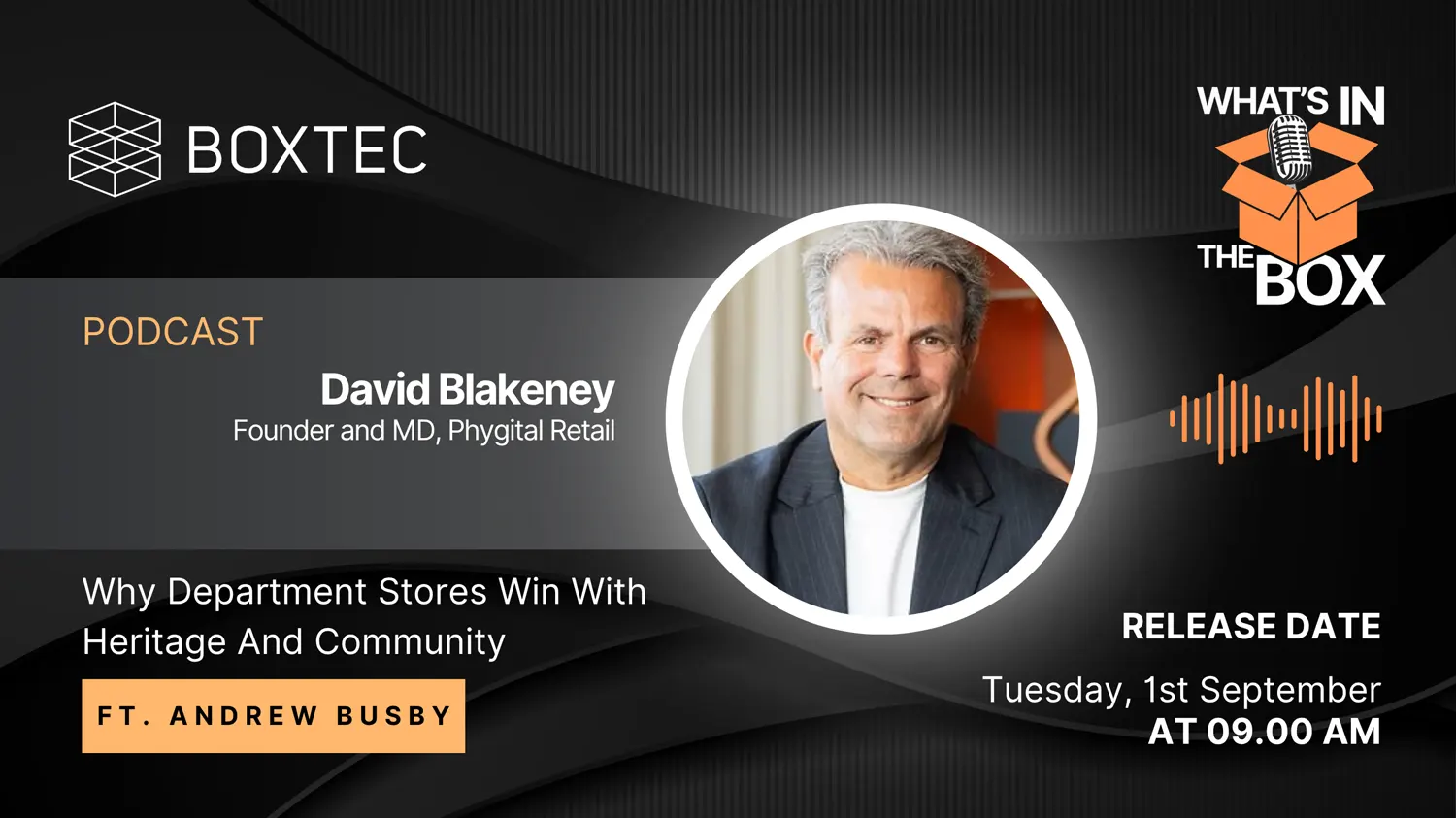
A luxury department store changes hands and the real question isn’t “who bought it” it’s “what’s the plan”. We talk with retail veteran, and founder of Phygital Retail, David Blakeney about Frasers acquiring Harvey Nichols, why luxury brands get nervous when ownership shifts, and how a flagship store in Knightsbridge can either anchor the whole business or quietly pull it down if investment and direction don’t show up fast.
- Frasers acquiring Harvey Nichols and the risks of unclear vision
- Why luxury department stores need fast, visible investment
- What Selfridges and Fortnum get right about community and experience
- Jolly’s Bath as a heritage-led high street anchor
- How M&S Pantheon upgrades navigation, food, and store feel
- Why business rates distort high street recovery and what councils can do
- The surprising economics of cruise ship retail and captive audiences
A new episode will be dropping every two weeks, so please stay tuned.
Transcript
Host: 00:02
Welcome to What’s in the Box, brought to you by BOXTEC, powering retail with purpose. BOXTEC delivers innovative and market leading customer engagement solutions that turn business ideas into a performing reality. From design and integration to ongoing support and maintenance, we’re with you every step of the way. Now, my guest today has over 35 years experience in retail, working with over 200 major brands and for some of the UK’s leading retailers in various senior leadership roles, including 22 years at House of Fraser, where he became Director of Planning and Store Development. He created Phygital Retail to work with brands and retailers to help deliver physical store openings and expansion, digital brands to open physical stores, and brands and retailers in their overall physical store journey to support and innovate expansion in their existing portfolio. It’s a pleasure to welcome to What’s in the Box, David Blakeney.
David Blakeney: 01:02
Andrew, thank you very much for inviting me.
Host: 01:05
Thank you. Now I mentioned there in the introduction about House of Frasers, so let’s get right into it. I know we’re going to talk quite a bit about department stores, which I’m going to love. So, as at the time of recording this, it was just this week that Frasers announced that Harvey Nichols has joined the Fraser stable. And I wonder what your take is on that.
David Blakeney: 01:33
A bit of déjà vu at the moment, because nine years ago they took over House of Fraser exactly this way. We were fascinated to know what they were going to do. We now know what they’ve done. And I think I’m fascinated because to take on Harvey Nichols, which is a luxury department store, of course House of Fraser wasn’t, you’ve got to have great relationships, and understanding what their vision is, and I don’t think anyone knows that at the moment. Now people will be saying, are they going to turn it in and put all their own brands in, like Flannels and people like that? But Harvey Nichols is a lot more than just a few brands who are under the Fraser stable. So I know that Harvey Nichols Knightsbridge has spent quite a lot of money on all their floors, but the top floor. How do they shake that up? Will they keep that particular store or will they turn that into just a Flannels store? And a couple of things. So what about Edinburgh? Or if you go to Leeds, they’ve got a beautiful Flannels they’ve opened in Leeds. So they ain’t going to put a Flannels into the Harvey Nichols there. So all these regional ones, it would be very interesting to see what they do. They’ve obviously done, will do, very good deals on the property, because let’s face it, anyone saddled with a high property cost and the business rates, it’s very hard to do what you want to do. So I think they’ll have some flexibility there, and I’m sure they worked it out. But the big thing is if you don’t have a Harvey Nichols flagship, the rest of Harvey Nichols collapses really. Maybe not abroad, because when you look at how well Debenhams are positioned abroad versus here, I think Harvey Nichols abroad will be really good for them. I think they’ve got a lot more flexibility. But it’s the UK I’m interested in. And that’s a big thing. And I suppose for me the only way you can go with any department store in the luxury sector is the way Harrods and Selfridges have gone. And you’ve got to take that model really, because it works for them. And it’ll interesting to see whether they take a little bit more that model, whether they do more, I mean, food and beverage to me and Harvey Nichols would be critical. They were always known for food and beverage. How will they work that? They haven’t done the top floor there, so they’ll have to invest in that. But when you look at Selfridges and their food and beverage now, Alto is a typical example. I know the San Carlo guy as well. That Alto is incredible. They need to do those sorts of things to bring people in. The corner shop in Selfridges, all the little ideas that I think Harrods and Selfridge’s did, which are massive earners for them, it’s that sort of innovation that I think can make a big difference to them. Will they?
Host: 04:30
And of course, there’s a question of what’s being said is that part of the turnaround, it needs a 60 million injection. Now, I’m not sure, I don’t know if you know whether that is in infrastructure, building, IT, or all of the above, but are Frasers going to be willing to do that?
David Blakeney: 04:50
Well, the integration will be interesting whether they integrate it into their own systems and that’ll obviously cost. I think a lot is down to they think that’s what money they are needing to spend in their stores to upgrade. So I think it’s important that was the investment in the stores. Because you can’t just carry on as it is. And it’d be interesting to know what are they going to bring to the party that no one else can do. So, I mean that Knightsbridge site is absolute prime.
Host: 05:26
Yes.
David Blakeney: 05:27
And if you get that right, they’ll make a lot of money out of it. What they do with it? no one knows, do we?
Host: 05:34
I know we’re speculating, but it is always quite fun to do that.
David Blakeney: 05:39
I think the problem is you can’t wait too long. Like Fraser’s of Glasgow, they’ve bought the building, but they haven’t done the investment that they should have done. And if you’re not careful, you lose your customers very quickly, unless they can see change. So they’ve got to surely be on a bit of a time frame in order to keep customers interested before they all disappear.
Host: 06:03
Yes, and I’ve heard that some of the luxury brands are a little bit nervous because of what happened a couple of years ago at Matches Fashion.
David Blakeney: 06:10
Yes, yes.
Host: 06:12
They purchased it in December and put it in administration in March.
David Blakeney: 06:16
Yes.
Host: 06:18
Which, yeah, slightly strange. I remember I did a fireside chat with Nick Beat in the April. I can’t repeat much, he did say a couple of things off air, but clearly things weren’t didn’t go quite according to plan with that. So hopefully, but hopefully the same thing won’t happen with Harvey Nichols. I don’t think it will do.
David Blakeney: 06:46
I think with department stores generally, the industry would love them to come out and tell us what their plans are. Now, I think they’ve probably not had time to think about it. I think they do the first thing then think after. Certainly with House of Fraser, it was done that quickly, they get it and then they try and work out what they’re going to do with it. But at least they got the Fraser’s name out of it, that was a good thing for them.
Host: 07:11
Well, yes, and of course, with this one, they were up against Next, although I think Next might have pulled out earlier in the summer. It was a really strange one, I didn’t quite get that. The Next customer would have been confused by that. But, just talking about Next, they’ve just opened Next at Fraser’s. So, the old House of Fraser at Blue Water, big, big store. I remember going in there many times, that is now a Next. Now, I haven’t been there yet. I’m planning to go in the next few days, but that is a big store to fill. I believe that it is all to be next. There aren’t the concessions, it’s not a marketplace or anything like that. So, that’s a heck of a lot, and I presume it is full-on, full fat, Next fashion and home, isn’t it?
David Blakeney: 08:10
I’m noticing Next doing more and more consolidation, and when they want to then expand their existing store in size. I know Blue Water, I opened that store for Hoff. I remember when we did it. It’s quite a rare centre, it’s got incredible parking there. I mean, probably three, four times more than anyone else. It’s not got great transport links, it’s got poor transport, but the footfall in there is enormous. It’s a fantastic centre, and I think it’s perfect for Next. It just fits, it fits them well, and I think they’ll become a massive destination.
Host: 08:52
Yes.
David Blakeney: 08:53
I think it’ll be interesting to see whether it takes away from other Next’s in that area that they’re in. Because why wouldn’t you go to the big Next with all the car parking? Why would you go to a smaller one? Yeah, when you’ve got that one. So the one thing I’ve never heard or read about is does it then have a knock-on effect on their other stores, on the way to where that customer comes from, which I presume it’s all the Kent customers and the Essex customers as well. I’m sure they get a lot of the Lakeside customers who go there now as well.
Host: 09:26
Yes, absolutely. So let’s talk about department stores. You know, you pretty much built a spell on cruise ships, which we’ll come on to, which is fascinating. But department stores, and I just wanted to get your views on you know, the we talked about House of Fraser, we could also talk about Fortnum, Liberty, you mentioned Harrods, Selfridges, and they’re all kind of iconic in their own way. With Selfridges, the sense of heritage goes back to 1909 when dear old Harry opened that store. With heritage comes community, I guess. I just want to get your thoughts on that, and where department stores fit into our lives.
David Blakeney: 10:12
I think to me, the department stores that do best are at the luxury part of the market because they’re in the right location. So your Harrods and Selfridges, I think, have adapted brilliantly to what they needed to be. They’re, you know, when you look at what Selfridges have introduced in the last year or two, if you pass it, they’re creating a Selfridges community by their loyalty cards. And I think they’ve got three million people who signed up already. They’re doing a lot more in the VIP areas, personal shopping areas. They’ve got that corner shop, their F&B’s superb, Alto is just off the scale in in takings for such a small area, which you can’t use for anything else. So it just goes to show you can make department stores work if you know what strings to pull. And I think obviously Harrods and Selfridges have done well. And Fortnum & Mason, I think more than Liberty are, to be honest. Fortnum’s are absolutely brilliant with what they’ve done. They continue to grow. And the things they do for their community in that store, the events, and the F&B side, it’s so relevant what they do today; who would have thought a department store like that might survive? But they survive because they hit all the right buttons for all their customers. And whenever you go in there, to me, it feels like such a traditional store. It’s got that real feel. I love it in here. And you just walk around, you just love walking around. And I know it’s not really fashion, it’s more gifty or whatever. And I think that’s their big bonus, is that everyone goes there to buy a gift so they can take it home as a present, or you take it home for a birthday present, and that’s what they do well. And they cross that over with travel retail brilliantly. So I think they’ve managed to nail the thing between the gifts, the food, the heritage, the community, and everything they do just goes to show that they’re focused on what they’re best at and what they can do, and they’re doing really well. For me, that’s the only way any department store will survive is to find that niche and you work it.
Host: 12:34
Yes, I guess that they need to be famous for something.
David Blakeney: 12:38
Yes, good. So, at the moment I’m working on the Jolly’s department store in Bath. And Jolly’s I did in 2014 for House of Fraser, and when we did that store, to me, everything about that store is heritage, it’s 200 years old. Everything about that store is about the Bath community and, in a way, your second community in Bath is that you’ve got a massive amount of tourists there. I think the most visited place outside London now in the country is Bath. I think it’s just pipped Edinburgh now. So it’s that basis that makes that store. In 2014, people were saying to us when we were refurbishing that store, don’t ruin our store, don’t make it a typical modern-day department store. I said, I’ll do you a favour. I said, I’ll tell you what we’re going to do, we’re going to give you your store back.
Host: 13:38
Yes, yes.
David Blakeney: 13:39
In other words, we’re going to focus on the heritage, and actually, we didn’t focus on community well at all. That was a really poor side. We did a reasonably good job on the heritage, and we made a big deal about all the heritage. We even put heritage plaques around the store, which were like the blue plaques, and we said, Did you know? And it’d be: “Did you know this was Queen Mary’s fitting room in 1853?” Yeah, and another one, did you know? And because we have buy and collect, or click and collect, we put a heritage scene, did you know in 1875? “They had buy and collect in a different way”. What it was, was a horse and carriage, and they delivered 14,000 parcels a year to all on horse and carriage, and that was in the 1850s. So when we talk it’s a bit like the milkman syndrome, isn’t it?
Host: 14:31
Yes.
David Blakeney: 14:32
What was a milkman is just evolved into what we’ve got today, without the sort of technology? So Jolly’s at Bath, in my opinion, the opportunities there are immense. Everyone in Bath loves Jolly’s, everyone wants Jolly’s, and when we talk about the effect on the high street, since Jolly’s have closed, Milsom Street footfall’s probably reduced by 40%. When everyone knew we were going to take a store there and open, or Morley’s were going to open their store there, suddenly all the shops on the right hand side have been let. ME+EM open there just two, three weeks ago. If ME+EM are opening there, it shows they’ve got confidence. Well, we’ve all got confidence in Bath, but confidence in Milsom Street. And the idea is to make that Milsom Street almost both, that heritage street, but also, I think in a way, it has to be a mixture of fashion, a mixture of gifts, a mixture of something for the tourists to have, but the locals as well. So the locals what they want and the tourists what they want. And if you can do a bit of both, everyone will be happy, and that’s the way they’ll take it. And they’re going to push the heritage and remind everyone, this is what this store’s about. And you know, up front they’ve got a big Jolly’s sign. Someone contacted me the other week, and said “I would like to do a guilt edge gold leaf sign for you”, because for four generations, their family have always done the signage going back 120 years. But we’d like to do that one sign and do it as it was done 80 years ago. So he’s going to do that for us. So you’ve got all those little great stories of what people want to do because it it’s in their blood. Yes, that makes sense. And also, I don’t know if you know, but in 2030 they are going to be opening a fashion academy there, or fashion museum. So it’s a massive, I think it’s a 20-30 million pound investment creating a fashion museum, and that’s what they need to do in Bath. They want to create more and more things for people to see. So, when you get that sort of thing, I think Jolly’s will make sure that they’re in tune with that, because everyone’s going to see the fashion, they want to see that. It’s all this historic thing people are interested in. So I think that to me could be a great opportunity.
Host: 17:12
Now, talking of which, I was in the M&S Pantheon store the other day. And wanted to get your views on that. I thought it was a fantastic store. First of all, it irritated me actually, because the escalator didn’t go up. It was steps and the escalator coming down. But then you saw on the steps, going from the ground, the Beauty area, up to first of all, Men’s, I think, and then up again to Homeware, they’ve got the history of M&S written on the steps, so you can read it as you go up. You know, starting, I think, from 1938, which is when it first started trading there. But I just thought little touches like that, the way they’ve used a very cream, some people would say beige, but I prefer the cream palette. The fonts they’ve used on the signage and how that’s been presented. I just thought, again, going back to your point earlier, it was a very pleasant place to be.
David Blakeney: 18:21
Yes. I think, first of all, what they’ve done on food is remarkable. And I’d say to everyone that I think someone there has implemented something called the common sense book. It’s common sense, say on the food, have wider files, have clear signage, just simple signage so you can find things. Yes, nice presentable cabinets, whether it’s open cell or not. Make your bakery exciting. Do your little elements of the bakery, or the Japanese food, or the fruit, make that come to life. And it’s just simple things that make that. And if you want to find a toilet, you can find the toilet because the sign says you don’t need to ask three people to find it. I think they’ve just applied that rule. And we as retailers walk around, don’t we? And we’re always trying to criticise everyone else’s store, oh, they’ve not done this and not done that. You never say, and it’s a typical thing. Or they go, it’s great, but they’ve not done this. I find it very hard to find fault in some of those food halls. I think they they’ve applied that now to fashion. It was interesting because only recently Zara have done that on the corner of Bond Street store. Zara take their shop fit upper level in a bit of a way that you would argue that it has a bit of a feel of M&S, it’s a bit of the way that Zara seem to be wanting to get.
Host: 20:01
Oh, yes, particularly the M&S store of Battersea.
David Blakeney: 20:04
Yes, and there’s a little bit of that, but I think they’ve done it very nicely to suit their own brand. But what they’ve done is they’ve definitely elevated the brand. And in the old days, they relied on just great merch, great clothing or great quality merchandise, but always really not nice tours. And now suddenly I think they are able, will be able to attract someone who really wouldn’t want to go into M&S, but they might buy the odd thing. People will want to go into Pantheon and shop. Like I will shop in Zara, but I never thought I would ever shop in Zara. But I like the store and I like what they’ve done, some of their t-shirts I love. The same thing, I think, with M&S now. It’s a nice enough place to shop that it makes you feel good, it’s got good fitting rooms, good lighting, easy to navigate, and their clothing matches. And what they’ve done is made the stores match the quality, and how they’ve improved in the quality of the clothing and the design and everything. They’re matching that with the store design now. And I think most people I’ve spoken to, oh my god, it’s amazing. I want to go there again. I think people who are on the cusp going, I’m not quite sure if I want to buy from M&S, will go, “Oh, it’s not a taboo like it was, I’m proud to be in there now”. They’ve done a brilliant job, and I think that’s what they’re going to get out of it.
Host: 21:35
I think so, yes. Because one of the things with flagship stores is that they’re just that, it doesn’t get rolled out. But I could see that they could roll out most of the elements of Pantheon across a large percentage of their stores.
David Blakeney: 21:51
You know, I phoned my wife and said, You’ve got to come here and have a look, it’s fabulous.
Host: 21:54
Yes. Yes.
David Blakeney: 21:56
And I’ve never done feminine before. I have on the food, but never the fashion, so that says it all, doesn’t it?
Host: 22:05
Now I mentioned it earlier and we’ve got a couple of minutes left. So moving away from sponsors, well, a couple of things. First of all, let’s quickly talk about what our new Prime Minister has come out with again earlier this week of this recording. He’s got it in for vape shops and Turkish hairdressers. I wrote an article this week and said that all you need to do is just dust the cobwebs off the Portas Review and Grimsey One and Two reviews. Take the best fits from all of those, and there you go. But do you think that this is just handing out a few more sweeties, and of course if we talk about the high street, we have to talk about business rates?
David Blakeney: 22:56
Well, when I saw his comments on the vape shops, you’re going to increase business rates on vape shops and things like that. And you’re thinking, so what are you going to do? Are you going say to Tesco’s, who sell vapes, you’re going to put their rates up as well? So any shop that sells vapes, you’re going to put their rates up? And why pick on the vape shops? It seems like he’s highlighting they are the problem on the high street. But we all know the problem is business rates, and it’s clear. So when will a government get their head around that. The problem is it gets worse and worse, because in London you get away with it, you’ve got enough footfall. Manchester city and the city centres, as you get to the next tier down and the tier down before that, they just can’t afford to rent, never mind the business rate, and there’s not enough footfall. What they did with prisons, they brought in Lord Timpson, because he had a bit of an interest in prisons and 10% of his workforce are prisoners. But they brought someone in from the outside. At what point would they bring in an expert actually into the government to lead that retail overview? British retail consortium are always having a go at them about do this, do this. But they don’t understand the reality of the issue with our shops and where the blockages are, and they didn’t listen to Grimsley, they didn’t listen to Portas. I remember listening to David Lammy talking, we’re going to give a million and a half to some town or whatever, and what are you gonna do with it? I’m going, you haven’t got a clue. I wish a Lord Rose or one of the greats, I mean, Simon Wolfson, if he ever wants to step down, it would be incredible. It’s almost that you need a minister for food, for retail, who understands the problems and what you can do. But until you employ someone like that, if you’re gonna be a football manager, you’ve got to understand football, yeah? You can’t bring in a government minister on a football team, can you? Because they don’t understand it. Well, there’s no difference with retail. You’ve got to bring in someone and listen to them. It’s all very well Burnham having a go at those. But I went on to Oxford Street the other week, four sweet shops are closed down, and all they’ve done is hoarded it up, it’s got graffiti, it looks ugly. So it’s all very well kicking them all out, but you’ve got to fill them with something, if not, it looks like the whole of the town centre is closed down. Now, Oxford Street obviously is getting better. I think most of those sweet shops are gone. But don’t close them down until you’ve got something to take their place. Now, the clever thing with Westminster Council, some empty shops in Oxford Street, they partnered with Someday Studios, Becky her name is, and they funded some of those empty shops for small businesses, and funded the ability to fill them with interesting new businesses and they helped do it all, and they didn’t charge them anything. So they were filling the stores with something a bit more interesting. That’s the way to do it. If you’ve got a good council, it will really help as well. And therefore, there needs to be someone who can get all councils to be on the same wavelength, but then it’s down to money. But, to me, they’ve got to get the right person to run it.
Host: 26:43
Yes, absolutely. Last thing I just wanted to ask you, we’re way over time, but that doesn’t matter. Something completely different to the high street and business rates and Andy Burnham and all the rest of it. Retail on cruise ships. Now you were telling me before a little bit about this, and I thought I really want to cover this because it’s absolutely fascinating. Tell me about it because I know you spent a number of years, and have got a lot of experience in this.
David Blakeney: 27:12
I was fortunate that I managed shops on cruises in the 80s, late 80s, and I was very involved with Carnival Cruises when they were just becoming big. And now Carnival, biggest cruise ship company in the world, own eight different lines. I was very lucky that I had a fantastic relationship with a co-founder of Carnival. And I could tell how much money cruises were taking. We took $100,000 on a cruise for a thousand people in those days in the eighties. That’s five million dollars a year, two and a half million pounds a year on a cruise ship with tiny little shops. And I said to the co-founder, send your people to see what Heathrow are doing. So we sent them over. Oh my God. I said Heathrow will become a shopping mall one day, which it is becoming.
Host: 28:03
And look at it now.
David Blakeney: 28:05
So they’ve definitely moved on. And what’s now happened is they’re still very backward in the way they retail, the way they operate, but they take so much money. You know, once you’ve got a captive audience, even with the shops ashore, they take a lot of money. And I think it’s a fascinating business. I think cruise ships should be more on people’s agenda because it is incredible business. And by the way, when you look at the beauty salons in the early days, it had just a couple of beauty rooms. These ships now got 25 to 30 beauty rooms. They take fortunes in what they did, and that all started mainly through a relationship between Carnival and Steiner, who were the original people on the QE2, and they ended up doing 80% of the cruise ships. But it’s the most incredible business now out there. So if anyone does go on a cruise ship, they’ll see.
Host: 29:08
Maybe I’ll take a cruise rather than walking down the high street, I’ll take a cruise to have a look at retail.
David Blakeney: 29:14
Yes, yes.
Host: 29:18
David, that’s fantastic. Thank you so much. So that’s all we’ve got time for now for What’s in the Box. A new episode will be dropping every two weeks, so please stay tuned. Thank you for listening, and thank you so much, David Blakeney.
David Blakeney: 29:25
Pleasure, thank you.